Reverse Osmosis System Installation in New Jersey
A reverse osmosis system holds the few gallons a day you actually drink to a higher standard.
Reverse osmosis system installation is among the most thorough drinking water treatments a New Jersey homeowner can put under a kitchen sink, and it is the one that generates the most questions. This page goes past the basics: how the stages work, what installation takes in a Summit single-family versus a Newark condo, what NSF/ANSI 58 certification does and does not promise, what upkeep costs, and how the numbers compare with bottled water.
The problem
Why NJ homes need reverse osmosis systems
Most of the water your home uses never touches your lips. It washes, flushes, and rinses. The few gallons a day you drink and cook with deserve a higher standard than the rest.
Municipal water is treated to meet drinking-water standards, but it travels a long way to reach your glass, through miles of mains and then through your own plumbing. Older homes may still have lead-bearing solder or brass fittings in the line. And even good water can carry enough dissolved solids to cloud your ice and flatten the taste of your coffee.
Many families answer this with bottled water. That means hauling cases, storing plastic, and paying again and again for something your kitchen sink could produce on its own.
The fix
How it works
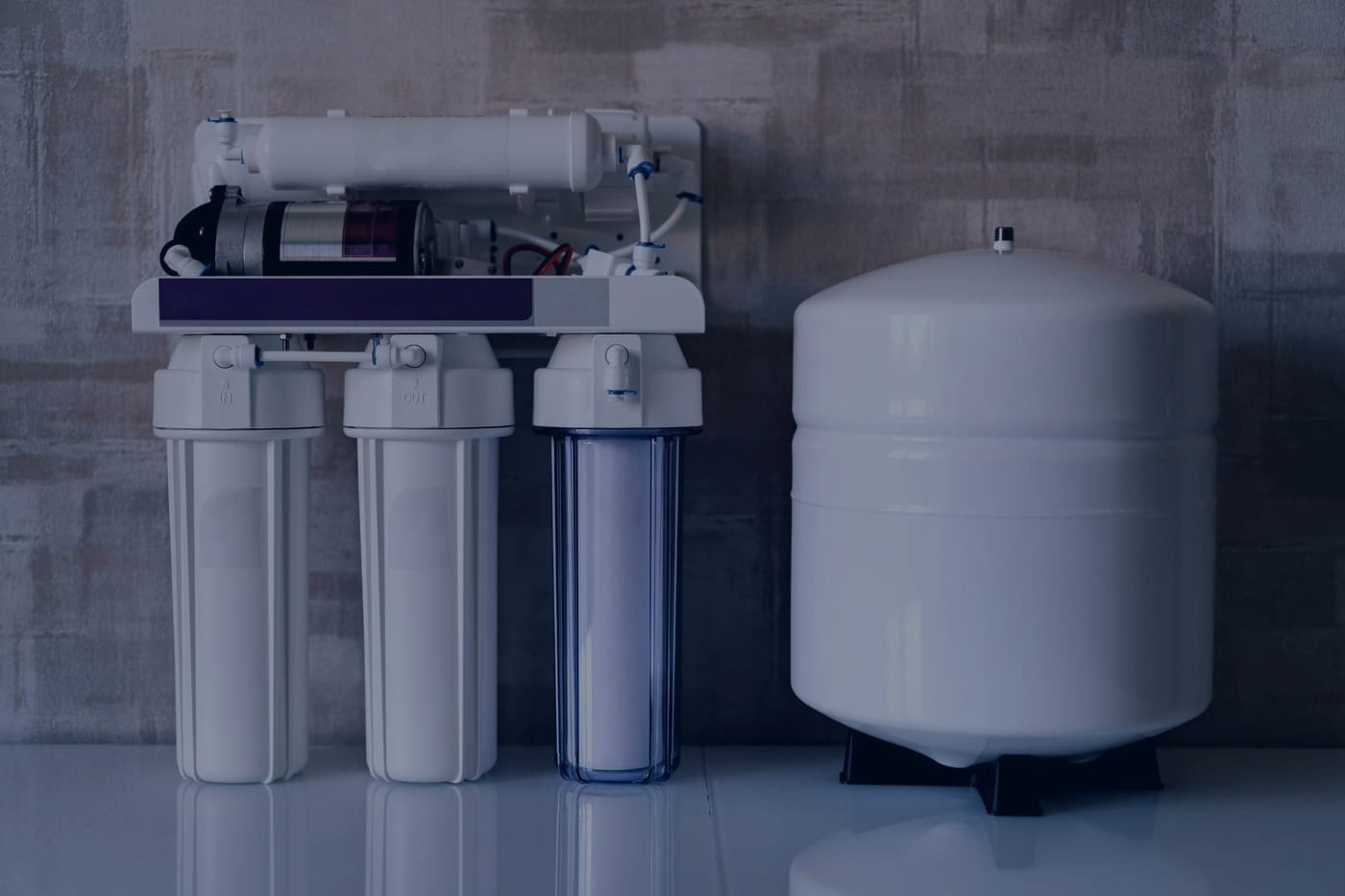
A reverse osmosis system fits under the kitchen sink and treats only the water you drink and cook with. Water passes through sediment and carbon prefilters, then is pressed against a semipermeable membrane. The membrane lets water molecules through and sends dissolved solids down the drain. Treated water waits in a small pressurized tank and pours from its own dedicated faucet.
The result is low-mineral, clean-tasting water for drinking, coffee, ice, and cooking. We can tee the line to your refrigerator's dispenser and ice maker, and add a remineralization stage if you prefer a crisper mineral taste.
A licensed New Jersey master plumber handles the installation (the sink connection, the dedicated faucet, the drain fitting, and the fridge line), so it is done cleanly and to code.
Free in-home estimate
We talk through what you want from your drinking water and give you a free quote from Jersey Water Pros. If you want the numbers behind your tap water, your utility's annual water quality report lists them, and official results come only from an NJDEP-certified lab test, which we can help arrange.
Pick your configuration
Basic under-sink RO, a remineralization stage, a refrigerator and ice maker line. We tell you exactly which unit you are getting and what its paperwork does and does not claim.
Installation
A licensed NJ master plumber mounts the system, sets the dedicated faucet, and pressure-tests every connection. Most kitchens are done in one visit.
Easy filter care
Prefilters and the polishing filter change on a routine schedule, and the membrane runs on a longer cycle. We track your dates and send reminders.
Certified equipment
NSF/ANSI 58 is the certification standard for point-of-use RO. It verifies total dissolved solids reduction, and individual models carry additional certified claims, such as lead or arsenic reduction, listed on their performance data sheets. Our tank style unit is not certified as a system; the tankless unit we install when it is in stock is certified to NSF/ANSI 58 for total dissolved solids reduction. We tell you which one you are getting.
How a reverse osmosis system works, stage by stage
A reverse osmosis system does not strain water the way a filter does. It pushes it. Household pressure presses water against a semipermeable membrane. EPA describes the result as two streams: treated water called permeate, and a reject stream called concentrate or brine.
| Stage | What it does |
|---|---|
| Sediment prefilter | Catches grit, rust and pipe scale before they reach the membrane. |
| Carbon prefilter | Strips chlorine, which attacks thin-film membranes. This stage guards the most expensive part. |
| RO membrane | The separation itself. Treated water goes forward, concentrate goes to the drain. |
| Storage tank | Holds the output, because a membrane produces only a few gallons an hour. |
| Carbon polishing filter | A last pass on the way out, so water that sat in the tank tastes fresh. |
| Remineralization, optional | Puts calcium and magnesium back for a rounder taste. |
Two parts surprise people. The storage tank is not a plain jug. A sealed air charge behind a bladder is what pushes water up to your faucet. The dedicated faucet is not a style choice either. Treated water leaves slowly and at low pressure, so it needs its own tap and a small drain connection for the concentrate line. An automatic shutoff stops production once the tank is full.
Reverse osmosis system installation in NJ homes, condos and apartments
Reverse osmosis system installation looks different depending on the kind of home you live in, and northern New Jersey has all three kinds on the same block.
- Single-family homes. The easy case. Most kitchen sinks have a spare hole for a sprayer or soap dispenser, and that hole takes the dedicated faucet. Without one, the counter gets drilled, and granite or quartz needs the right bit and a steady hand.
- Condos and co-ops. Buildings in Newark, Elizabeth, East Orange, Union and Morristown have rules. Associations often want written approval before work under a sink, plus proof the contractor is licensed and insured. Some control the shutoff for your line, so the work gets scheduled with a super. None of that stops the job. It just has to be settled first.
- Rentals. Ask your landlord in writing first. The system can go in leaving almost nothing behind: use the existing sprayer hole instead of drilling, and keep the original parts in a box.
Small jobs inside someone else's building carry real leak risk under a closed cabinet, and not every contractor wants them. We take them, and we put the approval steps in writing before we start.
Two rules shape the work in New Jersey. Water treatment installs are plumbing work, and New Jersey licenses master plumbers under the State Plumbing Licensing Law of 1968 (N.J.S.A. 45:14C-1 et seq.). Permits run through the state Uniform Construction Code, where some plumbing work is classified as minor work and other work needs a permit first. Your local construction official makes that call, not a contractor and not a website. Our plumber confirms what your town wants before the job starts.
What a reverse osmosis system removes, and what it does not
An NSF/ANSI 58 certified reverse osmosis system is tested against a defined list. NSF says the standard covers safety of materials in contact with drinking water, structural integrity, TDS reduction performance, an efficiency rating, a recovery rating, contaminant reduction performance, and the information given to the end user.
Two things follow. TDS reduction is the one required claim, so every certified system carries it. Everything beyond that is optional and model-specific, from cyst and lead to arsenic and VOCs. A system is certified only for the contaminants printed on its own performance data sheet, and that sheet is the only thing we quote.
PFAS, and the part most sites leave out. EPA reports that RO membranes are typically more than 90 percent effective at removing a wide range of PFAS, including shorter chain PFAS. That is research on the technology, not a promise about any product. Certification is what you can hold a manufacturer to, and our reverse osmosis is not certified for PFAS, so we never promise you a PFAS number.
Here is the honest limit of that certification. NJDEP states that products are certified for reducing PFOA and PFOS to below 20 parts per trillion, and that these products are not certified for removal down to the lower New Jersey MCLs of 14 parts per trillion for PFOA and 13 parts per trillion for PFOS. New Jersey also sets an MCL of 13 parts per trillion for PFNA. NJDEP adds that water quality, PFAS concentration and operating conditions all affect how well a home device performs. So a certified RO system is a strong reduction tool, and certification by itself is not proof that your treated water meets a state limit. Anyone who guarantees you a number below the state MCL is going past what the certification says.
For federal context, EPA finalized MCLs of 4.0 parts per trillion for PFOA and PFOS on April 10, 2024. In May 2026 EPA proposed to let systems request until 2031 to comply and to rescind the limits for several other PFAS. Those are proposals, and the PFOA and PFOS limits stand.
What it does not do. An RO system treats one tap. It does nothing for your shower or your water heater, and it will not protect appliances from hardness. That is a softener's job, under NSF/ANSI 44. If bacteria is the concern on a well, that is ultraviolet treatment under NSF/ANSI 55. Because the membrane pulls minerals out with everything else, some people find the water tastes flat. A remineralization stage answers that. It is a preference, not a requirement.
Reverse osmosis system maintenance and filter changes
A reverse osmosis system asks little of you, but it does ask. The prefilters are the reason the membrane lasts, and they are the stage people skip.
- Sediment and carbon prefilters. Published guidance puts changes at roughly every six months to two years, depending on the system. Your real interval depends on your water and your usage, so we set yours at install. Housings get sanitized while the system is open.
- Membrane. Systems carrying the EPA WaterSense label must show a membrane life of at least one year. Common replacement guidance runs about every three to five years, with the membrane itself often quoted at $50 to $100.
- Polishing filter. Changed with the prefilters, since it is the last thing your water touches.
- Tank pressure. With the tank drained, manufacturers typically call for a small air charge, commonly quoted around 6 to 8 psi. Your tank's own label is the authority. Low pressure is the usual reason a faucet dribbles.
An inexpensive TDS meter is the honest way to watch a membrane age. Take a reading when the system is new, write it down, and check once a year. When the treated reading creeps toward your untreated tap reading, the membrane is spent.
If you want to know what is in your water in the first place, start with your utility's annual water quality report, which every public community system publishes. On a private well, or when you want current numbers, use an NJDEP-certified lab. We can help arrange that testing. This Old House estimates about $400 a year to run a residential system, counting filters and the water it uses.
Reverse osmosis system vs bottled water: running the cost math
The bottled water comparison is why many people look at one in the first place. We are not going to hand you a dramatic number built on a national average price we cannot stand behind. Use your own shelf price instead. Multiply what you actually pay per gallon by 365.
| Your bottled price per gallon | 1 gallon a day | 2 gallons a day |
|---|---|---|
| $1.00 | about $365 a year | about $730 a year |
| $1.50 | about $548 a year | about $1,095 a year |
| $2.00 | about $730 a year | about $1,460 a year |
Now the other side. This Old House puts a point-of-use system at $150 to $1,300 installed, listing materials at $50 to $1,000 and labor at $150 to $300, then about $400 a year to run once it is in. Those are national estimates, not a New Jersey quote, and the daily use figures above are assumptions rather than measurements of your household.
Read the table honestly. At one gallon a day and a low shelf price, the yearly numbers are close, and the system still has to earn back its install cost first. The gap opens as your price per gallon rises or your daily use goes up. Two gallons a day changes the picture quickly.
We do not publish a price for your kitchen because we have not seen your kitchen. Ask for a free quote and you get a written number for the exact certified model, installed by a licensed New Jersey master plumber.
Go deeper
More on reverse osmosis systems
Jersey Water Pros installs reverse osmosis systems across Union, Essex & Morris County, NJ, using equipment you can verify in the NSF certified product listings. Curious what’s in your water where you live? Check your town’s water profile.
Signs you need it
- Buying bottled water for taste
- Cloudy ice cubes
- Flat or metallic-tasting coffee and tea
- A salty or mineral taste in tap water
- You have a softener and want the sodium out of your drinking water
- White residue left behind when water boils away
What changes
- Noticeably cleaner-tasting water and clearer ice
- One system can replace the bottled water run
- Better coffee, tea, soup, and rice, because cooking water matters
- Certified reduction claims you can read for yourself on the model's data sheet
- Compact and out of sight under the sink
- Feeds your refrigerator dispenser and ice maker too
FAQ
Reverse Osmosis Systems questions
How much water does an RO system send down the drain?
Some water rinses the membrane and goes to the drain. EPA says a typical point-of-use system sends five gallons or more to the drain for every gallon it treats, and inefficient units can reach ten. Systems carrying the EPA WaterSense label must send 2.3 gallons or less per gallon produced. We give you the efficiency rating of the model we quote before you buy.
Does reverse osmosis remove minerals from drinking water?
Yes. Reverse osmosis lowers total dissolved solids, and that includes calcium and magnesium along with the contaminants the system is certified to reduce. For most households it is a taste question, and a remineralization stage puts those minerals back if you want them. We do not give health or dietary advice. If you have a specific reason to watch your mineral or sodium intake, ask your doctor, and bring your utility's annual water quality report or a certified lab result with you.
What size storage tank does an RO system need?
Most under-sink tanks are rated 3 to 4 gallons, but the rating is not what you get. Part of the tank is air, so manufacturers put usable water at roughly 50 to 60 percent of the rating. A 4-gallon tank may pour about 2 to 2.5 gallons before it needs to refill. Households that cook a lot or fill bottles daily should size up rather than down.
How long does a reverse osmosis system installation take?
Most under-sink installs are a single visit. What changes the time is the faucet hole. If your sink has a spare hole, the job moves quickly. If a granite or quartz counter has to be drilled, or you want a line run to the refrigerator, it takes longer. We give you a realistic window in the quote instead of a number we cannot keep. Expect to wait a few hours after start-up while the tank fills for the first time.
Do I need a permit for a reverse osmosis system in New Jersey?
That is your local construction official's call, and it is worth asking before anyone touches a pipe. Permits run through the state Uniform Construction Code, which classifies some plumbing work as minor work and requires a permit up front for other work. Towns apply the code, so the answer can differ from one municipality to the next. Our plumber confirms the requirement with your construction office and handles the paperwork.
Can I install a reverse osmosis system myself?
Kits are sold for DIY and plenty of people do it. Two things make us cautious. It is a pressurized connection inside a closed cabinet, and a slow leak there can go unnoticed for weeks. And in New Jersey, plumbing work is regulated under the State Plumbing Licensing Law of 1968, with permit questions decided by your local construction office. If you rent or own a condo, doing it yourself can also break your lease or your association's rules.
What is the lifespan of an RO system?
The housings, tank and faucet commonly last many years. The consumables do not, and they decide whether the system keeps working. Prefilters go on a schedule, and common replacement guidance puts the membrane at about every three to five years. A neglected system does not fail dramatically. It quietly stops reducing much of anything, which is why we track your dates for you.
Does a reverse osmosis system remove PFAS?
EPA reports that RO membranes are typically more than 90 percent effective at removing a wide range of PFAS, including shorter chain compounds. That is research, not a product guarantee. Our reverse osmosis is not certified for PFAS. If you need a certified PFAS reduction, look for NSF/ANSI 53 or 58 for PFOA and PFOS, or NSF P473, and ask to see the listing. Read the fine print with us: NJDEP states that certified products are certified to reduce PFOA and PFOS to below 20 parts per trillion, and are not certified for removal down to New Jersey's lower MCLs of 14 parts per trillion for PFOA and 13 for PFOS. New Jersey's PFNA MCL is also 13 parts per trillion.
Can bacteria grow in a reverse osmosis system?
Any wet system can build biofilm over time, which is why housings get sanitized at filter changes and why filters should not sit past their schedule. An RO unit is not a disinfection device and is not certified as one. If bacteria is a real concern, such as on a private well, that calls for ultraviolet treatment certified to NSF/ANSI 55, installed ahead of the RO unit.
Ready to fix your water?
Tell us what you’re dealing with and get a straight written quote from a local pro. No pressure, no sales script.