Well Water Filtration Systems in New Jersey
On a private well, you are the water company. The right well water filtration system makes the job manageable.
Well water filtration works best when it is built from numbers instead of guesses. The sections below add the detail behind the overview above: what northern New Jersey wells actually test high for, which equipment each finding calls for, what the parts cost, and how the state testing law fits around all of it. The figures come from published state rules, the state's own well test data, university extension guidance and published supplier price lists, and every source is listed at the end.
The problem
Why NJ homes need well water filtration
When your water comes from a private well, no utility treats it and no one monitors it but you. New Jersey's geology makes that a real job. Wells in our region can pull up iron that stains fixtures orange, manganese that leaves black marks, hydrogen sulfide that smells like rotten eggs, and acidic water that slowly eats copper pipe from the inside.
Some problems are invisible. Naturally occurring arsenic has been found in private wells in parts of northern and central New Jersey. It has no taste or smell. Only a lab test finds it. That is one reason the state's Private Well Testing Act now requires arsenic testing statewide whenever a home with a well changes hands.
The Act also means well problems tend to surface at the worst possible time: in the middle of a real-estate transaction, with a closing date already on the calendar.
The fix
How it works
There is no single machine that fixes well water. There is a right sequence of equipment for your well's specific chemistry, and it starts with testing through an NJDEP-certified lab, because only certified lab results are official. We can help arrange that testing, and we design from what it finds.
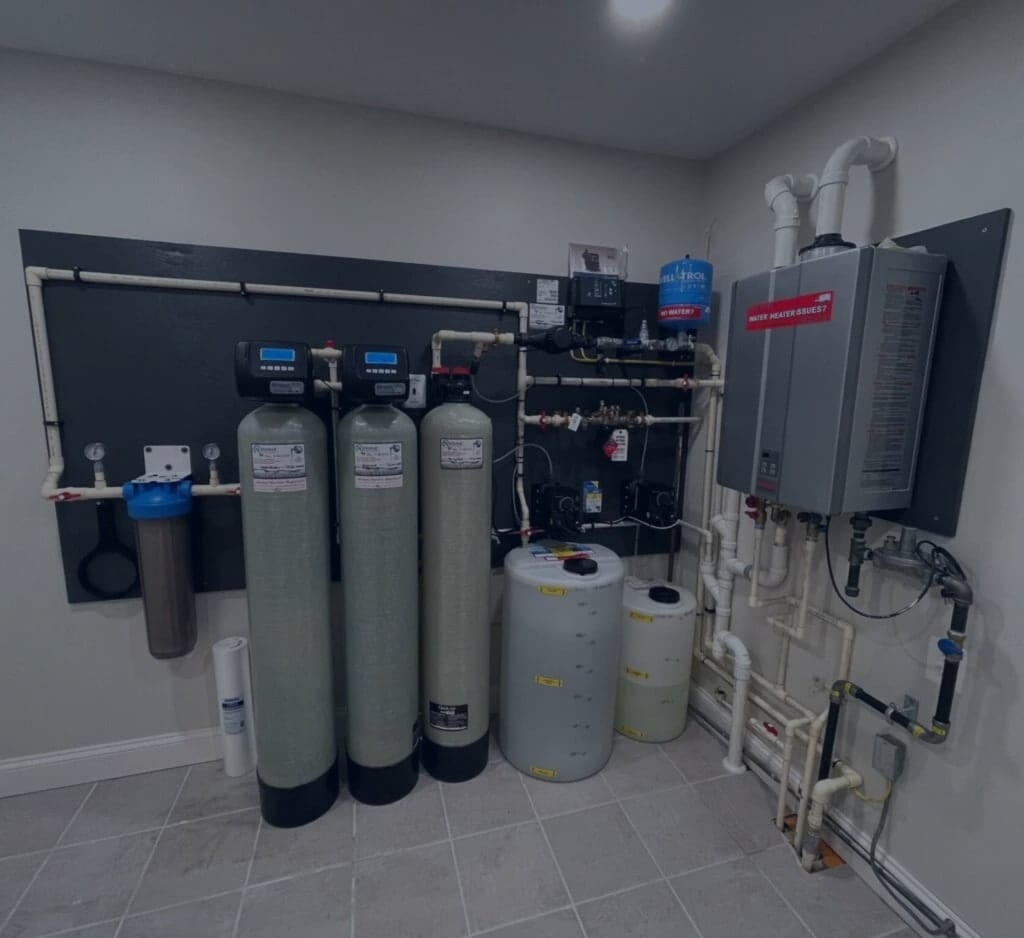
From those results we build the well water filtration system your water actually needs:
- Iron and manganese: oxidizing filtration that turns dissolved metals into particles and traps them, ending the orange and black staining.
- Sulfur odor: media systems that target hydrogen sulfide, the source of the rotten-egg smell.
- Acidic water: a neutralizing filter that raises pH before low-pH water can keep corroding copper plumbing.
- Bacteria: whole-house ultraviolet disinfection.
- Arsenic: reduction only through systems certified for arsenic under NSF/ANSI 53 or 58.
A licensed New Jersey master plumber installs every component in the correct order, to code. Then we help arrange a follow-up lab test, because a treatment system you have not verified is just a guess in a tank.
Test first
Everything begins with an NJDEP-certified lab test, which we can help arrange. The lab covers basics like hardness, iron, and pH, and it is the only official route for bacteria, arsenic, or a Private Well Testing Act transaction.
Design the treatment train
We design the sequence of equipment your lab results call for, and nothing they do not. You get it in writing, component by component, with each certification listed.
Licensed installation
A licensed NJ master plumber installs the system at your well line, in the correct treatment order, with bypass valves so every component can be serviced.
Verify and maintain
After the install, a follow-up NJDEP-certified lab test confirms the water matches the design, and we help you arrange it. Then we keep media, UV lamps, and filters on schedule so it stays that way.
Certified equipment
Well treatment combines components, and each carries its own standard. Certification is the thing to check: UV disinfection certified to NSF/ANSI 55 (Class A) for bacteria and other microorganisms, and arsenic reduction certified under NSF/ANSI 53 or NSF/ANSI 58. We tell you what the equipment we quote is and is not certified for. We verify every component's certified claims before we recommend it.
Common well water problems in northern New Jersey
The most common well water problems in northern New Jersey are not exotic. It is the same handful of findings, over and over, and each one is a different job for a well water filtration system. New Jersey's Private Well Testing Act report on 51,028 wells sampled between September 2002 and April 2007 shows how often each one turned up statewide.
| Finding | Limit or marker | Share of the 51,028 wells sampled |
|---|---|---|
| Low pH | Below 6.5 (EPA secondary range is 6.5 to 8.5) | 44 percent below 6.5 |
| Iron | 0.3 mg/L EPA secondary standard | 29 percent above |
| Manganese | 0.05 mg/L EPA secondary standard | 19 percent above |
| Total coliform | Present or absent | 13 percent positive |
| Fecal coliform or E. coli | Present or absent | 2.2 percent positive |
| Nitrate | 10 mg/L as nitrogen | 2.7 percent above |
Two more findings never show themselves in a glass of water. New Jersey regulates arsenic more tightly than the federal government does. State rules set a maximum contaminant level of 5 ug/L for arsenic, against the federal 10 ug/L. And every Private Well Testing Act sample in the state is analyzed for gross alpha particle activity using the 48 Hour Rapid Gross Alpha Test, with samples from twelve counties also analyzed for uranium. Union, Essex and Morris are all on that uranium list, along with Bergen, Hudson, Hunterdon, Mercer, Middlesex, Passaic, Somerset, Sussex and Warren. For those two, New Jersey applies the federal limits: 15 picocuries per liter for gross alpha and 30 ug/L for uranium.
Sulfur odor is the exception to the numbers. Penn State Extension notes that most people can detect hydrogen sulfide well below 0.5 mg/L, so the rotten egg complaint usually arrives long before a report looks dramatic. Low pH is the quiet one. It rarely tastes like anything, and the first evidence is often bluish green stains in sinks or small leaks in the plumbing.
Well water treatment systems, matched to your lab results
A well water filtration system is a sequence, and each stage gets chosen from a number on the report. These are the parts we assemble most often, and the published thresholds that decide between them.
- Iron and manganese filters. Penn State Extension recommends oxidizing filters when the combined iron and manganese concentration is in the range of 3 to 10 mg/L, and says that above 10 mg/L the most effective treatment is oxidation followed by filtration. Air injection filters do the oxidizing with a pocket of air held in the tank, so there is no salt to carry and no chemical to mix.
- Acid neutralizers. A tank of calcite media raises pH as water passes through it. Penn State Extension is direct about the tradeoffs: the media has to be refilled routinely, the process increases the hardness of the water, and the resistance of the media bed can lower water pressure. The added hardness is one reason a softener sometimes follows a neutralizer.
- Ultraviolet disinfection. Systems certified to NSF/ANSI 55 for microbiological water treatment. NSF's certified listings show units carrying either a Class A or a Class B disinfection performance claim, so the class is worth checking on the listing itself before you buy. UV needs clear water. Iron, manganese and sediment absorb and scatter the light, so they are removed ahead of the lamp rather than after it.
- Arsenic media. The certified claims are written for one form of arsenic and for a capped influent level. NSF lists the claim under NSF/ANSI 53 as Arsenic (Pentavalent) less than or equal to 50 ppb Reduction, and under NSF/ANSI 58 as Arsenic (Pentavalent) less than or equal to 300 ppb Reduction. That wording matters. It means the certification covers pentavalent arsenic up to a stated concentration, so the design has to start with what your lab report says rather than with a filter picked off a shelf.
- Softeners on wells. Cation exchange softeners certified to NSF/ANSI 44 carry a hardness reduction claim, and NSF's listings show some units adding certified claims for barium reduction and radium 226/228 reduction. Penn State Extension recommends a softener only when pH is greater than 6.7, hardness is between 3 and 20 grains per gallon, and dissolved iron is less than 5 mg/L. Past that, the resin fouls.
Order is part of the design, and it is what separates a working well water filtration system from a pile of tanks. Sediment first, then oxidizing filtration, then pH correction and softening, with UV last so it treats water that is already clear.
What well water filtration costs in New Jersey
Well water filtration is priced by the stage, so published numbers give you a range and not a quote. One regional supplier lists an iron and sulfur filter at $1,795 to $2,195, an acid neutralizer at $1,195 to $1,895, a UV system at $895 to $995 and a sediment prefilter at $145 to $195, with complete well setups listed between $1,500 and $6,500 and a full five system stack at $6,275 to $7,475. Those are equipment prices from a direct seller and they exclude installation. The same supplier puts a local plumber at $200 to $500 to install one or two systems, which is a useful floor rather than a New Jersey quote.
Three things move the number more than anything else. How many stages your lab report calls for. Tank size, which follows your household's peak flow rather than your square footage. And the condition of the plumbing where the system ties in, since a licensed New Jersey master plumber has to install it with bypass valves and get it inspected.
Ongoing cost is smaller and steadier. The same supplier lists UV lamps at $145 to $160 on a twelve month replacement cycle and quartz sleeves at about $60 to $80 every two to three years, and calcite has to be topped off routinely. You get the whole sequence priced in writing, component by component, and the quote is free.
Well water and the Private Well Testing Act
Well water and the Private Well Testing Act meet at one rule that surprises people. The sample has to be raw. Under N.J.A.C. 7:9E-2.3, where a treatment system is in use on the property, it must be disconnected or otherwise disabled before the sample is collected, or the sample must be collected at a location ahead of it. An existing filter cannot make a report look better than the well is.
The required parameter list is longer than most people expect. It covers total coliform, with E. coli follow-up on a positive, plus nitrate, iron, manganese, pH, lead, arsenic, every volatile organic compound with a state maximum contaminant level, and gross alpha particle activity by the 48 Hour Rapid Gross Alpha Test. The rule added 1,2,3-trichloropropane, ethylene dibromide and 1,2-dibromo-3-chloropropane as of March 3, 2019, and the three PFAS compounds PFNA, PFOA and PFOS as of December 1, 2021. New Jersey's maximum contaminant levels for those three are 0.013 ug/L for PFNA, 0.014 ug/L for PFOA and 0.013 ug/L for PFOS, which the state also states as 13, 14 and 13 parts per trillion.
Two timing rules are worth knowing. Results stay valid for one year for the sale of a property, except coliform, which stays valid for six months. A landlord whose rental is on a private well must test at least once every five years and, within 30 days of receiving the results, give a written copy to each rental unit and each new tenant. The full parameter list, the notification steps and what to do with a failure are covered in our Private Well Testing Act guide and our page on failed well tests. That raw water report is exactly what a well water filtration design should be built from.
Morris County well water filtration
Morris County well water is a bigger part of daily life than anywhere else we serve, so well water filtration here is routine work rather than a specialty. In the state's 2002 to 2007 Private Well Testing Act report, 4,645 Morris County wells were sampled, against 80 in Essex County and 33 in Union County. Statewide, the New Jersey Department of Health puts private wells at about 13 percent of New Jersey residents' drinking water.
Those Essex and Union sample counts are too small to read a county rate from, so treat them as a sign of how few wells are left in the built up parts of our service area rather than as a measurement. Morris is the county with enough data to say something. In that period, 2.4 percent of the 4,645 Morris wells were positive for fecal coliform or E. coli and 1.7 percent were above the nitrate limit. Of the 3,104 Morris wells measured against New Jersey's 5 ug/L arsenic standard, 1.8 percent exceeded it.
Within Morris, the municipalities with the most wells in that arsenic sampling were Mount Olive with 397, Chester Township with 382, Washington Township with 368 and Jefferson Township with 336, followed by Roxbury, Rockaway Township, Randolph, Kinnelon, Mendham Township, Montville and Harding.
Read all of it as a picture of the county two decades ago, not a forecast for your well. Wells a quarter mile apart can test differently. The only number that describes your water is the one on your own lab report.
Go deeper
More on well water filtration
Jersey Water Pros installs well water filtration across Union, Essex & Morris County, NJ, using equipment you can verify in the NSF certified product listings. Curious what’s in your water where you live? Check your town’s water profile.
Signs you need it
- Orange or brown stains in tubs, toilets, and laundry
- Black specks or dark staining from the tap
- Rotten-egg smell, especially in hot water
- Blue-green stains below faucets or pinhole leaks in copper pipe
- Water that turns cloudy after heavy rain
- A failed or flagged Private Well Testing Act result
What changes
- The staining stops on fixtures, laundry, and dishes
- The sulfur smell is gone from every tap
- Low-pH water stops corroding your copper plumbing
- Lab-verified results instead of guesswork
- Equipment matched to your well, so you never pay for treatment you do not need
- A cleaner path through a home sale under the Private Well Testing Act
FAQ
Well Water Filtration questions
How often should I test my private well?
The EPA recommends testing a private well every year for total coliform bacteria, nitrates, total dissolved solids and pH, and testing more often if the water changes in odor, color or taste, if any part of the well system is replaced or repaired, or if there are known groundwater problems in the area. In New Jersey, add what the Private Well Testing Act requires. Gross alpha is analyzed statewide, and samples from Union, Essex and Morris are also analyzed for uranium. Testing has to go through an NJDEP-certified lab, and we can help arrange it.
Does well water need a softener and an iron filter, or will one do both?
It depends on how much iron is dissolved in the water. Penn State Extension recommends a softener only when pH is greater than 6.7, hardness is between 3 and 20 grains per gallon, and dissolved iron is less than 5 mg/L. Above that, iron fouls the resin and you want a dedicated oxidizing filter ahead of the softener. Plenty of wells in our area end up with both, in that order: iron filter first, softener second.
What maintenance does a UV system need?
A lamp change about once a year, because output drops with hours of use, plus periodic cleaning or replacement of the quartz sleeve the lamp sits inside. One regional supplier lists replacement lamps at $145 to $160 on a twelve month cycle and sleeves at about $60 to $80 every two to three years. The bigger maintenance item is what sits upstream. Keep sediment, iron and manganese out, or they absorb the light and the delivered dose drops.
How much does a well water filtration system cost?
It depends on how many stages your lab report calls for. Published equipment prices from one regional supplier run about $895 to $995 for UV, $1,195 to $1,895 for an acid neutralizer and $1,795 to $2,195 for an iron and sulfur filter, with complete well setups listed between $1,500 and $6,500 before installation. Those are do-it-yourself equipment prices. Your written quote from us prices equipment and licensed installation together, component by component, and the quote is free.
Do I need a permit to install well water filtration in New Jersey?
In most cases the work goes through your municipal construction office. New Jersey's Uniform Construction Code at N.J.A.C. 5:23-2.7(b) states that ordinary maintenance does not include the addition to, or alteration, replacement or relocation of water supply piping, and a whole house system is cut into that piping. Your town's construction office decides how a specific job is classified. State law at N.J.S.A. 45:14C-12.3 also restricts plumbing contracting and the master plumber title to licensed people. We subcontract to licensed New Jersey master plumbers and handle the permit side with your town.
My well failed a Private Well Testing Act test and closing is close. What now?
Start with the report, because the failure tells you the treatment. Bacteria, iron, manganese and low pH all have well established fixes that usually install in a day. Arsenic, gross alpha and uranium take more design. Results stay valid one year for a sale and six months for coliform, so a retest through an NJDEP-certified lab after the install gives you a clean paper trail. Call early, since lab turnaround drives the timeline more than the plumbing does.
The rotten egg smell is only in the hot water. Is that the well?
Not always. Penn State Extension explains that the magnesium rod inside a water heater can chemically convert sulfate into hydrogen sulfide, and that replacing it with an aluminum rod should end the rotten egg odor while still protecting the tank from corrosion. If the smell is in the cold water too, it is coming from the well, and a point of entry system is the answer. Most people can detect hydrogen sulfide well below 0.5 mg/L, so the odor shows up early.
My report flagged gross alpha or uranium. Will a standard well filter handle it?
No. Those are separate findings with their own limits: 15 picocuries per liter for gross alpha and 30 ug/L for uranium under the federal standards New Jersey applies. Gross alpha is a screening measure taken with the 48 Hour Rapid Gross Alpha Test, and the right follow-up depends on what is driving the result, which in our twelve county uranium testing area can involve uranium. Treatment gets selected against the specific number and the certified claims of the equipment, so send us the lab report and we will quote from it.
Does the Private Well Testing Act cover PFAS?
Yes, since December 1, 2021. The rule requires every Private Well Testing Act sample to be analyzed for PFNA, PFOA and PFOS. New Jersey's maximum contaminant levels are 0.013 ug/L for PFNA, 0.014 ug/L for PFOA and 0.013 ug/L for PFOS, or 13, 14 and 13 parts per trillion. For treatment, NSF's certified listings under NSF/ANSI 53 include separate PFOA and PFOS reduction claims, and some units carry a total PFAS reduction claim. Match the certified claim on the specific unit to the compound on your report.
Ready to fix your water?
Tell us what you’re dealing with and get a straight written quote from a local pro. No pressure, no sales script.