
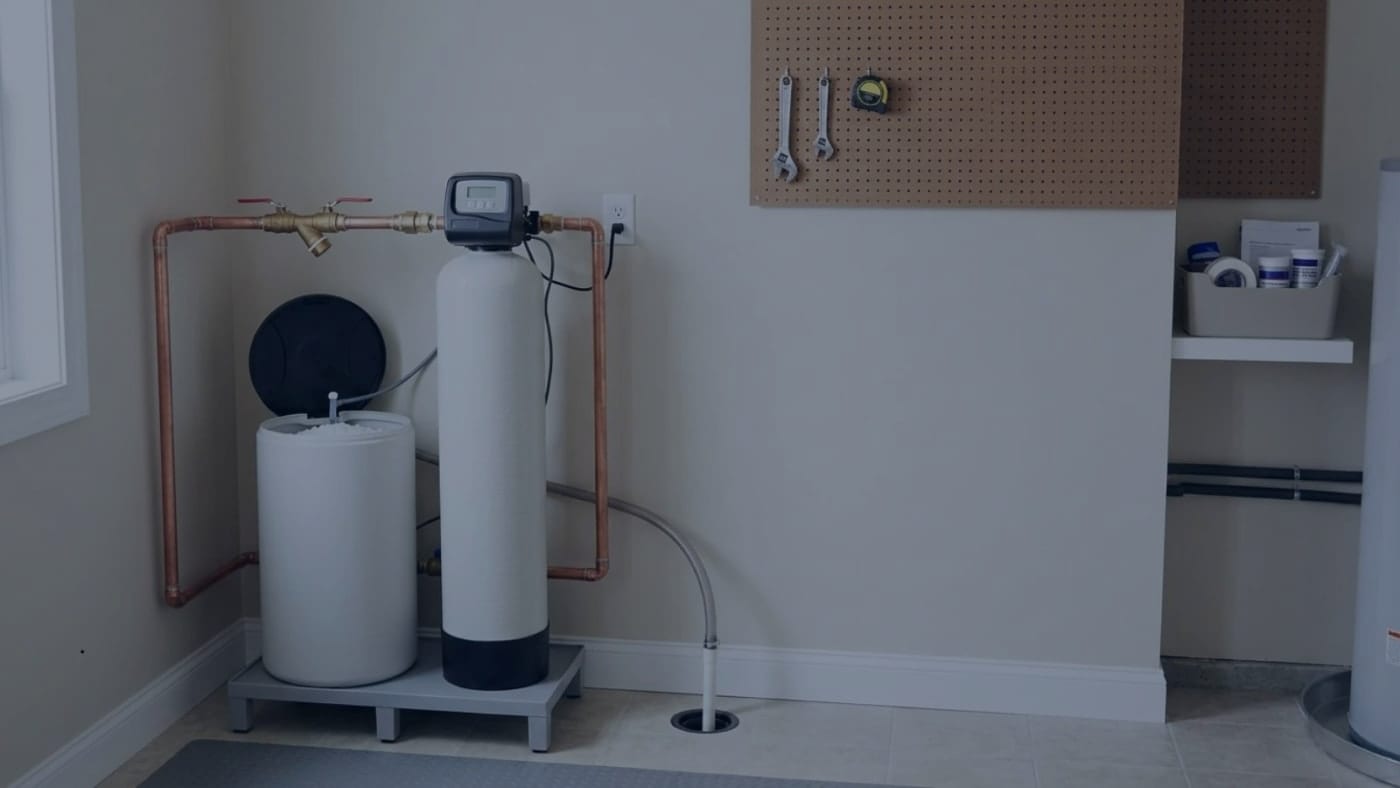
Water Softener Installation in New Jersey
Water softener installation sized to your home's hardness, for soft water at every tap.
Water softener installation is a plumbing job, not an appliance delivery. The unit has to be cut into your main water line, given a bypass, tied to a drain that meets code, and programmed to the hardness your house actually has. Here is what that looks like in a New Jersey home: what happens on install day, what the state requires on paper, what the work costs, and how hard the water really is in the towns we serve.
The problem
Why NJ homes need water softener installation
Hard water is water carrying dissolved calcium and magnesium. Utilities are not required to remove those minerals, because hardness is not treated as a health issue. It is a wear-and-tear issue, and your house pays for it.
The evidence is easy to spot. White crust on faucets and showerheads. Spots on glassware and film on shower doors. Soap that will not lather, laundry that comes out stiff, and skin and hair that feel coated after a shower. Inside your water heater and appliances, hardness builds scale you never see. Over time, scale makes equipment work harder and can shorten its life.
How hard is your water? We do not quote regional averages. If you are on city water, your utility's annual water quality report lists what it found. On a private well, official results come only from an NJDEP-certified lab test, which we can help arrange. Either way, we use your real numbers to size a softener correctly, and we serve homes across the Union, Essex, and Morris county area.
The fix
How it works
A water softener fixes hardness where the water enters your home. Inside the tank, a bed of resin beads holds sodium or potassium ions. As water passes through, the resin grabs calcium and magnesium and releases sodium in trade. That ion exchange is the whole trick. What comes out is soft water, at every tap.
When the resin fills up, a metered control valve rinses it with brine and the softener is ready again. We size the system to your hardness numbers and your household's actual water use, so it regenerates only when it needs to and does not waste salt or water doing it.
Every installation is performed by a licensed New Jersey master plumber. That means a proper bypass valve, a code-compliant drain connection, and workmanship you can point to when you sell the house.
Free in-home estimate
Every project starts with a free in-home estimate from Jersey Water Pros. We look at your plumbing and walk through your water numbers with you: your utility's annual water quality report if you are on city water, or an NJDEP-certified lab test, which we can help arrange, if you are on a well. If hardness or iron levels are worth confirming with a lab, we will say so.
Right-size the system
We match softener capacity to your hardness numbers, household size, and plumbing, then give you a written quote naming the exact certified model.
Installation day
A licensed NJ master plumber installs the softener at your main water line with a bypass valve and a code-compliant drain. Most installs finish in a single visit.
Walkthrough and follow-up
We show you how to add salt, read the valve, and reach us, then follow up to confirm the system is performing the way we sized it to.
Certified equipment
We install softeners certified to NSF/ANSI 44, the standard for residential cation-exchange water softeners. Certification verifies the hardness-reduction performance, capacity rating, and material safety the manufacturer claims.
The water softener installation process in NJ
Most of a water softener installation is done in a single visit, in a basement or utility room within reach of the main water line. The plumber shuts the water down, cuts into the main after the meter, and arranges the piping so the softener treats the house but skips what does not need it. Toilets, hose bibs, and irrigation lines are commonly left on hard water. The Minnesota Department of Health gives the same advice: soften only what you need to. It notes that toilets, hose bibs, basement sinks, and other cold water taps typically do not need to be connected to a softener.
Three connections define the job.
- Inlet and outlet. These go on the main line, upstream of the water heater so it stops collecting scale, and downstream of any sediment or iron filter. Penn State Extension puts it plainly: filtration prior to softening ensures that oxidized iron is not processed in the softener. Iron that has already met air or chlorine clogs the resin, so pre-filtration comes first when your water calls for it.
- The bypass valve. It sits at the softener head. Turn it and the house runs on untreated water while the unit is serviced or replaced, without shutting the whole home down. It is the part homeowners are gladdest to have five years later.
- The drain line. Regeneration waste leaves through an indirect connection to a standpipe, laundry tub, or floor drain, with an air gap so nothing can be siphoned back into the softener. Indirect waste piping is governed by New Jersey's plumbing subcode, which is the National Standard Plumbing Code/2024, adopted at N.J.A.C. 5:23-3.15(a)1. Inspectors look closely at this connection.
Programming is the last step. The control valve gets your real hardness number, not a regional guess. Minnesota's health department warns that a softener set too high costs more to operate and wastes water. Set it too low and hard water slips through. Then comes a manual regeneration, a pressure check on every joint, and a walkthrough on salt.
Permits and licensing for water softener installation in NJ
Yes, you need a licensed plumber. Water softener installation is regulated plumbing work under New Jersey's Uniform Construction Code, and two separate rules apply: one about the permit, one about who may do the work.
The permit. N.J.A.C. 5:23-2.14(a) makes it unlawful to install or alter any equipment regulated by the code without first filing an application and obtaining the required permit. The usual escape hatch, ordinary maintenance, does not reach this job. N.J.A.C. 5:23-2.7(b)6ii says ordinary maintenance shall not include addition to, or alteration, replacement or relocation of water supply, sewer, drainage, gas, soil, waste, vent or similar piping. The rule's list of ordinary plumbing maintenance runs to hose bib valves, ball cocks, faucets, valves, traps, leak repairs, and like-for-like fixture swaps with no change in the piping arrangement. Cutting a softener into the main and running a new drain is none of those.
Minor work. Some softener jobs get handled as minor work. Under N.J.A.C. 5:23-2.17A(a), a permit does not have to be issued before minor work begins, provided the enforcing agency is given notice first, and N.J.A.C. 5:23-2.17A(b)2 requires the permit application to be filed within five business days of that notice. One caveat worth stating plainly: the code's minor work list does not name water softeners, so the classification is your municipality's call rather than ours. Either way the permit is required. It just may not have to be in hand on day one.
The license. N.J.A.C. 5:23-2.15(b)2i is direct. Plumbing, electrical, heating, ventilating, air conditioning, and refrigeration, and master hearth specialist work shall not be undertaken except by persons licensed to perform such work pursuant to law, except in the case of a single-family homeowner on his or her own dwelling. That is the DIY exemption, and it is narrow. It covers an owner working on the single-family home he or she owns and lives in. It does not cover a rental, a two-family, a friend's house, or a handyman you hired. The same rule, at N.J.A.C. 5:23-2.15(b)2ii, requires the licensed plumbing contractor's seal and signature on the plumbing subcode application form.
Every water softener installation we sell is performed by a licensed New Jersey master plumber, with the permit pulled in your municipality, so the paperwork exists when you sell the house.
What water softener installation costs in NJ
Published figures give you a starting range, and every one of them is national rather than New Jersey specific. Thumbtack's cost data puts water softener installation between $564 and $1,692, with most people paying around $958, and prices a basic ion-exchange unit at $400 to $1,000 on its own. Homewyse reported in May 2026 that the estimated national average cost to install a water softener starts at $1,131 to $1,405 per softener, and its calculator adjusts that figure by ZIP code for local labor and material costs, so run your own ZIP rather than trusting the headline number. Penn State Extension puts the hardware alone at roughly $500 to $1,500.
The permit is the smallest line on the bill. Madison's construction fee schedule, for example, lists water softeners at $20 as a plumbing fixture, against a minimum plumbing permit fee of $75. Fees are set town by town, so yours will differ, and state surcharges can apply on top.
What really moves the number is your hardness level, the capacity that hardness calls for, whether iron pre-treatment is needed, and how accessible your main line is. We are building a full New Jersey cost guide with those variables broken out. Until it publishes, the honest answer is a free quote with the exact model named in writing.
How hard is the water here, and what size water softener it calls for
Hardness is not one number across Union, Essex, and Morris County. It swings by town, by source, and by season. These are the figures the utilities publish themselves.
| Town | Published hardness | Source |
|---|---|---|
| Westfield | 104 to 130 mg/L, or 6 to 7 grains per gallon | NJ American Water, Raritan System 1 |
| Summit | 80 to 240 mg/L, or 4.7 to 14.0 grains per gallon | NJ American Water, Short Hills System |
| Madison | 320 to 380 ppm, average 346 ppm, which converts to roughly 19 to 22 grains per gallon | Borough of Madison water quality report |
| Livingston | 13.7 to 29.5 grains per gallon, average 19.4, or 234 to 505 ppm | Livingston 2025 report, 2024 data, township's own supply |
On the scale Penn State Extension publishes, anything above 10.5 grains per gallon, or 180 ppm, is very hard. Madison and Livingston clear that line easily, and both exceed the 250 ppm recommended upper limit their own reports cite. Livingston's report lists carbonate hardness averaging 19.4 grains per gallon against a recommended upper limit of 14.6, and records that the limit was not achieved. The Minnesota Department of Health puts the practical threshold for considering a softener at 7 grains per gallon, or 120 mg/L. Westfield sits right at that line. Summit spans moderately hard to very hard inside a single system, which is exactly why we size from your report rather than a town average.
Livingston also blends in purchased water, and the same report lists those two purchased supplies at 9.3 and 25.8 grains per gallon. One township, three very different numbers.
Those numbers drive the sizing. Penn State's method is simple: gallons per person per day, times the number of people, times your hardness in grains. Using Penn State's own example figure of 75 gallons per person per day, a four-person Livingston home at the township's 19.4 gpg average strips roughly 5,800 grains a day, so a 32,000-grain softener regenerates about every five to six days. The same household in Westfield at 7 gpg strips about 2,100 grains a day and stretches the same unit past two weeks.
Water softener types we install
Every ion-exchange softener runs the same chemistry. What separates them is how the control valve decides to regenerate, and how much backup capacity you have.
- Metered, demand-initiated single tank. The default for most homes. The valve counts gallons and regenerates only when the resin is spent. Penn State Extension notes that timed models regenerate whether the resin needs it or not, wasting salt and water. We do not install timer-only units.
- Twin tank. Two resin tanks alternate so one is always in service. Worth considering for large households, for hardness at Madison and Livingston levels, or where a gap in soft water would be noticed.
- Softener with pre-filtration. Where iron or sediment is present, a filter goes ahead of the softener. Penn State Extension notes that red oxidized iron clogs the resin, so on well water and some hard municipal supplies this is not optional.
- Softener with point-of-use RO. Ion exchange trades hardness for sodium, and Penn State Extension puts that at 7.5 milligrams per quart for each grain per gallon of hardness removed. If that matters in your kitchen, the Minnesota Department of Health lists two common answers: keep an unsoftened tap for cooking and drinking, or regenerate with potassium chloride instead of sodium chloride. A third is an under-sink reverse osmosis unit certified to NSF/ANSI 58.
We do not sell magnetic or electronic descalers. They do not remove calcium and magnesium from the water, which puts them outside NSF/ANSI 44, the standard covering residential cation exchange water softeners, and we have not seen certification data supporting hardness-reduction claims for them. Everything we quote is certified to NSF/ANSI 44 for reduction of hardness, and the model is named in writing before the water softener installation is scheduled.
Go deeper
More on water softener installation
Jersey Water Pros installs water softener installation across Union, Essex & Morris County, NJ, using equipment you can verify in the NSF certified product listings. Curious what’s in your water where you live? Check your town’s water profile.
Signs you need it
- White crust on faucets and showerheads
- Spots and film on glassware
- Soap that will not lather
- Stiff, dingy laundry
- Skin and hair that feel coated after showering
- A noisy or underperforming water heater
What changes
- Scale stops building on fixtures and in appliances
- Water heaters and appliances tend to last longer without scale
- Soap and detergent work better, so you can use less
- Brighter laundry and softer towels
- Cleaner glassware and easier bathroom cleanup
- A smoother feel on skin and hair
FAQ
Water Softener Installation questions
Do I need a plumber to install a water softener in New Jersey?
In almost every case, yes. N.J.A.C. 5:23-2.15(b)2i says plumbing work shall not be undertaken except by persons licensed to perform such work pursuant to law, except in the case of a single-family homeowner on his or her own dwelling. So a homeowner may do the work on the single-family house he or she owns and lives in. Anyone else doing it for you, including a handyman, must be licensed. The exemption does not extend to rentals, two-family homes, or a job you do at a relative's house.
Do I need a permit for water softener installation in NJ?
Yes. N.J.A.C. 5:23-2.14(a) makes it unlawful to install regulated equipment without first filing an application and obtaining the permit, and N.J.A.C. 5:23-2.7(b)6ii keeps softener work out of the ordinary maintenance exception because it adds to and alters water supply and drainage piping. Some towns handle the job as minor work under N.J.A.C. 5:23-2.17A, which lets work start once the enforcing agency has been given notice, with the permit application filed within five business days. The code's minor work list does not name water softeners, so that classification is your municipality's call. The permit is required either way. Fees are local: Madison's schedule lists water softeners at $20 against a minimum plumbing permit fee of $75.
How long does a water softener last?
InterNACHI's standard life expectancy chart for homes lists a water softener at 20 years, which is longer than a conventional water heater at 6 to 12. In practice the control valve and the resin decide it. Very hard water works the resin harder, iron fouling shortens its life, and a unit programmed to the wrong hardness cycles more than it should. Treat 20 years as a reasonable planning number for a well-maintained system, not a guarantee.
What size water softener do I need for a 2,000 square foot house?
Square footage is the wrong input. Penn State Extension sizes softeners on people and hardness: gallons per person per day, times the number of people, times your hardness in grains per gallon gives the grains you remove daily. Using Penn State's example of 75 gallons per person per day, four people in Livingston at the township's 19.4 gpg average need about 5,800 grains a day, so a 32,000-grain unit regenerates roughly every five to six days. The same four people in Westfield at 7 gpg need about 2,100 grains a day, and the same unit runs past two weeks. Two houses of identical size can need very different softeners.
Can I use water or flush the toilet while the softener is regenerating?
Flushing a toilet is fine. Control valves are commonly programmed to regenerate in the early morning hours so the house is quiet, and many units keep water available to the taps during the cycle, though it comes through untreated while the resin is being rinsed. Toilets and hose bibs are often plumbed on the hard water side anyway. What is worth avoiding is a heavy draw mid-cycle, like a full laundry load, since Penn State Extension puts each regeneration cycle at about 50 gallons of water.
Is it cheaper to buy a water softener at Home Depot and have it installed?
Sometimes the box price is lower, and we have not price-checked any retailer's install service, so treat that as an open question. What does not change is the code. In New Jersey the install is still regulated plumbing work, the municipal permit still applies, and whoever does the work still has to be licensed unless you are the owner-occupant doing it yourself. The differences worth weighing are sizing to your actual hardness report instead of a shelf SKU, having the permit pulled for you, and knowing who answers the phone in year three.
How long does water softener installation take?
Most single-visit installs run a few hours once the water is off, assuming the main line is accessible and a drain is nearby. Jobs stretch when the softener has to sit far from the main, when a drain has to be run, or when iron pre-treatment goes in at the same time. We tell you which situation you are in at the estimate, not on install day.
Where does a water softener get installed, and does it really need a drain?
It goes on the main water line, after the meter and before the water heater, usually in a basement or utility room. It needs three things nearby: the main line, an electrical outlet for the control valve, and a drain. The drain is not optional, because regeneration flushes hardness and brine out of the resin and that waste has to go somewhere. It discharges as indirect waste through an air gap so nothing can be pulled back into the softener.
How do I find out how hard my water is before I get a quote?
If you are on city water, your utility's annual water quality report lists total hardness, usually in mg/L or grains per gallon. That is the number we size from. On a private well, official results come only from an NJDEP-certified lab test, and we can help you arrange that. Either way the in-home estimate from Jersey Water Pros is free, and we will tell you plainly if your hardness does not justify a softener.
Ready to fix your water?
Tell us what you’re dealing with and get a straight written quote from a local pro. No pressure, no sales script.