
Whole House Water Filtration Systems in New Jersey
A whole house water filter keeps chlorine in the water main and out of your morning coffee.
Whole house water filtration treats your water once, at the point where the main line enters the house, so every tap, shower, and appliance downstream gets the same treated water. The sections below go past the overview and into what homeowners actually ask about: how a point-of-entry system is built, how it compares with an under sink filter, what one costs, and why the disinfectant your utility uses changes the media we specify. Jersey Water Pros is based in Summit and serves Union, Essex and Morris County. Every install is performed by a licensed New Jersey master plumber, and the quote is free.
The problem
Why NJ homes need whole house water filtration
Your utility adds chlorine or similar disinfectants to keep water safe on its way to your house. That is good engineering. But the disinfectant is still in the water when it reaches your tap, and you can taste and smell it in a glass of water, in coffee and ice, even in shower steam.
Disinfection has a side effect, too. When chlorine reacts with natural organic matter in water, it forms disinfection byproducts. Utilities are required to monitor and limit them, and your utility's annual water quality report lists what it found. Many homeowners read that report and decide they want a layer of treatment of their own.
PFAS, the so-called forever chemicals, are a separate concern that has drawn attention across New Jersey. Reducing them is not a job for ordinary filters. It calls for equipment specifically certified for PFOA/PFOS reduction, which we cover below.
The fix
How it works
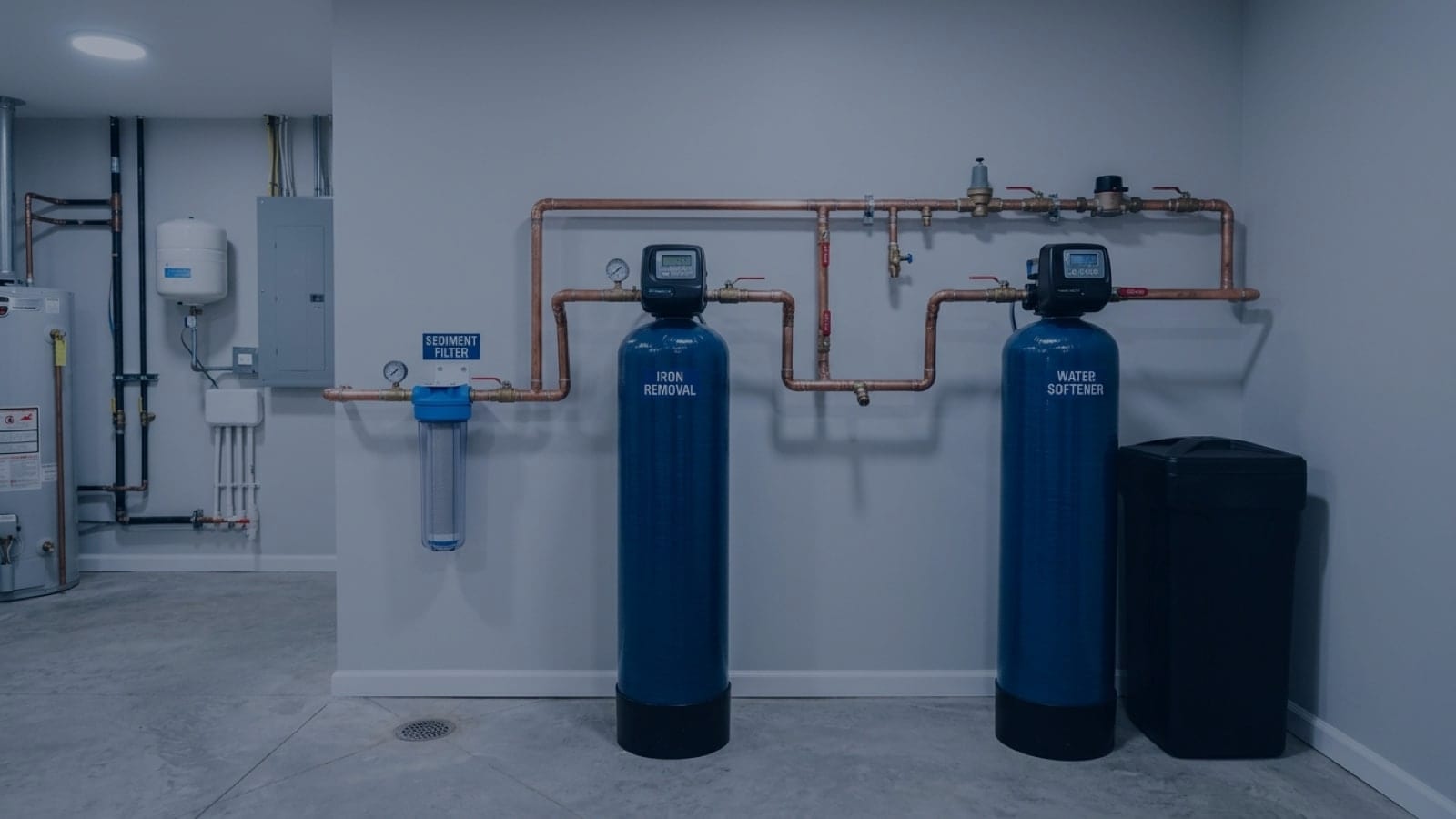
A whole house water filtration system treats water at the point of entry, so every tap, shower, and appliance gets the same filtered water. Inside the tank, activated carbon strips chlorine compounds and captures many of the organics behind bad taste and odor as water passes across its enormous surface area.
We match the media and the certification to your water and your goals. Standard activated carbon handles chlorine taste and odor. Health claims such as reduction of certain disinfection byproducts or PFOA/PFOS are certified under NSF/ANSI 53, model by model. Our whole house systems are not certified to NSF/ANSI 53, and we say so in writing; our carbon itself is certified to NSF/ANSI 42 for chlorine, taste and odor.
A licensed New Jersey master plumber installs the system at your main line with a bypass valve, so your plumbing stays serviceable and up to code.
Free in-home estimate
We review your utility's latest water quality report with you and talk through what you want your water to do. Official numbers come only from an NJDEP-certified lab, and we will say when lab testing makes sense and help you arrange it. You get a free quote from Jersey Water Pros before anything is installed.
Choose the right system
Taste and odor alone calls for an NSF/ANSI 42 certified carbon system. If you want health-related reduction claims, we quote equipment certified to NSF/ANSI 53 for those exact contaminants.
Installation day
A licensed NJ master plumber installs the tank at your point of entry with a bypass valve. Most homes are done in a single visit.
Simple upkeep
Carbon media has a service life that depends on your water use and chlorine level. We set your replacement schedule at install and remind you when it is due.
Certified equipment
Carbon systems certified to NSF/ANSI 42 are verified for aesthetic claims: chlorine taste and odor. Health-related claims, including reduction of PFOA/PFOS and certain disinfection byproducts, require certification to NSF/ANSI 53 for each specific contaminant. We only make reduction claims that a system's published certification actually covers.
How Whole House Water Filtration Systems Work
A whole house water filtration system is a point-of-entry system. The Minnesota Department of Health describes point-of-entry units as units that are installed on the water line as it enters the home. That is the whole design idea. One system, one location, every fixture downstream.
A typical build runs in stages:
- Sediment prefilter. Catches rust, grit, and pipe scale before they reach the carbon, which keeps the media bed from loading up early.
- Carbon tank. A bed of activated carbon that water moves through slowly enough to be treated. Chlorine and many taste and odor compounds stick to the carbon on the way past.
- Bypass valve. Lets a plumber isolate and service the system without shutting off water to the whole house.
Sizing is the part homeowners never see and always feel. Carbon needs contact time, so the tank has to match your service flow rate and your household demand. Undersize it and water moves through too fast to be treated well.
Media choice matters just as much. Standard granular activated carbon is built around free chlorine. Chloramine is a more stable disinfectant, and New Jersey American Water states in its annual water quality report that treatments to remove chloramines are different than treatments for removing chlorine. Where chloramine is the disinfectant, catalytic carbon is the media normally specified. NSF lists Chloramine Reduction as a certified claim you can look up by model under NSF/ANSI 42. Our catalytic carbon upgrade uses carbon certified to NSF/ANSI 42, and we show you that listing; the system as a whole does not carry a certified chloramine claim.
Whole House Water Filtration vs Under Sink Filtration
These two get compared as if they were competitors. They are not. A whole house system is point of entry. An under sink system is point of use, which the Minnesota Department of Health describes as a unit that treats water at one faucet or one location.
| Question | Whole house filter | Under sink filter |
|---|---|---|
| Where it installs | At the main line, usually the basement or utility room | In the cabinet under one sink |
| What it covers | Every tap, shower, tub, washing machine, and the water heater | The cold line at that one faucet |
| What it is good at | Chlorine and chloramine taste and odor, shower smell, sediment, protecting appliances | Polishing the few gallons a day you drink and cook with |
| Typical certification | NSF/ANSI 42 for aesthetic claims such as chlorine and chloramine reduction | NSF/ANSI 58 for reverse osmosis systems, NSF/ANSI 53 for health claims such as lead or PFOA and PFOS reduction |
| Upkeep | Media replacement on a schedule set at install | Cartridge changes, plus a membrane on a longer cycle |
They solve different problems. If the pool smell in your shower is the complaint, an under sink filter will never touch it. If you want dissolved solids out of your drinking water, a carbon tank at the main line will not do that either. Plenty of homes in our service area run both, and one visit covers the pair.
What Whole House Water Filtration Costs in New Jersey
We will not put a number on your house sight unseen, and you should be wary of anyone who does. What we can give you is the range the national cost guides publish, so you start the conversation with a frame.
Bob Vila's cost guide puts a home water filtration system at roughly $1,000 to $4,000, with a national average of $2,078. It reports labor adding $300 to $500 on top of material prices, permitting running $100 to $600, and maintenance of $50 to $300 per year. Those are national figures. New Jersey labor rates and municipal permit fees run on their own schedule, so treat that range as a starting point and not a quote.
What actually moves your number:
- Flow rate and household size, which set tank and media volume
- Media type, since catalytic carbon for chloramine costs more than standard carbon
- A backwashing tank system versus a simpler cartridge housing
- Whether a softener, UV, or sediment stage shares the same install
- The layout and condition of the plumbing at your main line, including whether a drain is nearby
We are building a full New Jersey cost guide for these systems. Until it is published, the fastest route to a real number is a free quote at /free-estimate. We look at your plumbing, read your utility's report with you, and put the model and its certification in writing.
Chlorine, Chloramine, and Whole House Water Filtration in Union, Essex and Morris County
Before you pick a filter, find out which disinfectant is in your water. In our service area the answer is not the same everywhere, and that single fact changes the media we specify.
New Jersey American Water says it brings over 30 years of experience using chloramine to treat water in its Raritan System, and has used it since June 2012 in its Coastal System. The company also notes that one in five Americans receives drinking water from systems using chloramination.
The 2025 annual water quality reports show how it plays out locally:
- Raritan System (PWS ID NJ2004002): the report states that groundwater supplies are disinfected with chlorine and surface water supplies are treated with chloramines for bacteriological quality in the distribution system. Surface water is 92 percent of that system's supply and groundwater is 8 percent. Distribution system chloramines show a highest compliance result of 1.2 ppm against an MRDL of 4, with a range of 0.02 to 4 ppm.
- Short Hills System (PWS ID NJ0712001): the report lists an entry point chloramine residual of 0.3 ppm with a range of 0.3 to 3 ppm, and a distribution system chlorine residual with a highest compliance result of 1 ppm and a range of 0.7 to 1.0 ppm. Its treatment summary says groundwater is disinfected with chlorine and surface water is treated with chlorine or chloramines. A 2025 public notice from this system covered parts of Millburn, Short Hills, and Springfield.
- Southeast Morris County MUA (PWSID NJ1424001), serving Morristown, Morris Township, Hanover Township, and Morris Plains, plus customers in several nearby towns: chlorine disinfection, with a highest locational running annual average of 1.34 ppm and a range of 0.00 to 2.46 ppm against an MRDL of 4.
So one system in our area reports chloramines through the distribution system, one reports chloramine at the entry point and chlorine in the mains, and one is chlorine. That is exactly why we ask instead of assuming. Chloramine holds a residual farther through the pipes and forms fewer disinfection byproducts, which is why utilities use it, and it is also harder to strip at the house. Carbon sized for free chlorine can come up short on chloramine.
Jersey Water Pros does not offer countertop water demonstrations, and you do not need one to start. Your utility's annual water quality report names its disinfectant and its residual levels, and we read it with you at the estimate. If a number needs confirming, that goes to an NJDEP-certified lab, and we help you arrange it.
PFAS and Whole House Water Filtration
PFAS is a separate question from taste and odor, and it deserves a separate answer. New Jersey enforces its own limits, and they appear right in the reports above: a maximum contaminant level of 14 ppt for PFOA and 13 ppt for PFOS. In the 2025 Raritan System report, PFOA showed a highest result of 7 ppt with a range of ND to 7, and PFOS a highest result of 6 ppt with a range of ND to 6, both under the state limits.
Ordinary carbon is not a PFAS claim. Reduction of PFOA and PFOS is a health claim, and only a system certified for it can be described that way. NSF lists PFOA Reduction, PFOS Reduction, and Total PFAS Reduction as certified claims under NSF/ANSI 53, the standard for drinking water treatment units and health effects. Reverse osmosis systems are certified to NSF/ANSI 58 for reverse osmosis performance, and a reverse osmosis model that carries a PFAS claim carries it under NSF/ANSI 53, since NSF's listing search does not offer PFOA or PFOS reduction as a claim under Standard 58. We show you that listing for anything we quote, and we never state a reduction the certification does not cover.
For the state limits, the detection data, and a comparison of carbon, anion exchange, and reverse osmosis, see our PFAS water filter guide at /whole-house-filtration/pfas-filter-nj.
Go deeper
More on whole house water filtration
Jersey Water Pros installs whole house water filtration across Union, Essex & Morris County, NJ, using equipment you can verify in the NSF certified product listings. Curious what’s in your water where you live? Check your town’s water profile.
Signs you need it
- Tap water that smells like a pool
- Coffee, tea, or ice with an off taste
- Chlorine smell in a hot shower
- Buying bottled water because of the taste
- A plastic or chemical taste in cold water
- You read your utility's water report and want your own layer of treatment
What changes
- Better-tasting water from every tap, not just one
- Coffee, tea, and cooking water without the chlorine edge
- Showers without the pool smell
- No monthly cartridge swaps at individual faucets
- Easier on rubber seals, gaskets, and appliance parts, which chlorine can wear down
- Fewer cases of bottled water to haul and store
FAQ
Whole House Water Filtration questions
Is it worth getting a whole house water filter?
It depends on what is in your water and what bothers you. If the chlorine or chloramine smell follows you into the shower, or coffee and ice taste off at every tap, whole house water filtration fixes that in one place. If your only complaint is the drinking water at the kitchen sink, an under sink system costs less and does the job. Read your utility's annual water quality report first, then decide.
What are the disadvantages of a whole house water filtration system?
Three real ones. It costs more upfront than a faucet or pitcher filter. It needs space near your main line with room to service it, and on a backwashing system, a code-compliant drain. And the media does not last forever, so replacement is a recurring cost. Carbon also does nothing for hardness or dissolved solids, so it is not a substitute for a softener or reverse osmosis.
How often does a whole house water filter need maintenance?
The sediment prefilter is the frequent item and gets changed as it loads up. Carbon media runs much longer, and how long depends on your water use and how much disinfectant the water carries, so there is no honest one-size answer. Bob Vila's cost guide puts maintenance for a home water filtration system at $50 to $300 per year. We set your schedule at install and remind you when it is due.
Can I install a whole house water filter myself, or do I need a plumber?
This is not a cartridge swap. It means cutting into the main potable water line, adding a bypass, and on a backwashing system, running a drain. A bad tie-in can flood a basement or create a cross-connection at the drain. Jersey Water Pros subcontracts every install to a licensed New Jersey master plumber, so the work is done to code and documented for when you sell the house.
Do I need a permit for whole house water filtration in New Jersey?
Plan on it. New Jersey's Uniform Construction Code lists a narrow set of ordinary plumbing maintenance items that need no permit, such as replacing faucets, valves, traps, or a fixture with a similar fixture where no change in the piping arrangement is made. Cutting a filter into your main line is not on that list. Even work classed as minor work still requires notice to the enforcing agency before the work starts and a permit application filed within five business days. Your municipal construction office is the authority, and our plumber handles the paperwork and the plumbing subcode inspection.
Does a whole house water filter remove chloramine?
Some systems are certified to reduce it and some are not. Chloramine is more stable than free chlorine, and New Jersey American Water's own annual report notes that treatments to remove chloramines are different than treatments for removing chlorine. Ask for a system certified to NSF/ANSI 42 for chloramine reduction, not just chlorine, and check the model in NSF's certified product listing. It matters here, because some systems in our service area report chloramine while others report chlorine.
Will a whole house water filter lower my water pressure?
A correctly sized system should not leave you noticing a difference at the shower. A pressure drop usually points to one of two things: the system was undersized for the home's flow rate, or the sediment prefilter is loaded and overdue. Sizing to your actual service flow at the estimate handles the first. A maintenance schedule handles the second.
Does a whole house water filter soften hard water?
No. Carbon adsorbs chlorine and organics. It does not remove calcium and magnesium. Hardness is handled by ion exchange in a softener certified to NSF/ANSI 44, the standard NSF lists for cation exchange water softeners and hardness reduction. If you have both the chlorine taste and scale on your fixtures, a softener and a carbon system installed together is a common setup in our service area, and one visit covers both.
Do I need a water test before buying a whole house filter?
Not always. On city water, your utility's annual water quality report already lists the disinfectant it uses, its residual levels, and its disinfection byproduct results, which is usually enough to specify a carbon system. Jersey Water Pros does not offer countertop water demonstrations. When numbers need confirming, or you are on a private well, official results come only from an NJDEP-certified lab, and we help you arrange it.
Ready to fix your water?
Tell us what you’re dealing with and get a straight written quote from a local pro. No pressure, no sales script.