Water Softener Installation in Scotch Plains, NJ
Softeners, whole house filtration, and licensed plumber installs for Scotch Plains homes, matched to what’s actually in Scotch Plains’s water.
Water source
New Jersey American Water, Raritan System 3 (PWSID NJ2004002)
Typical hardness
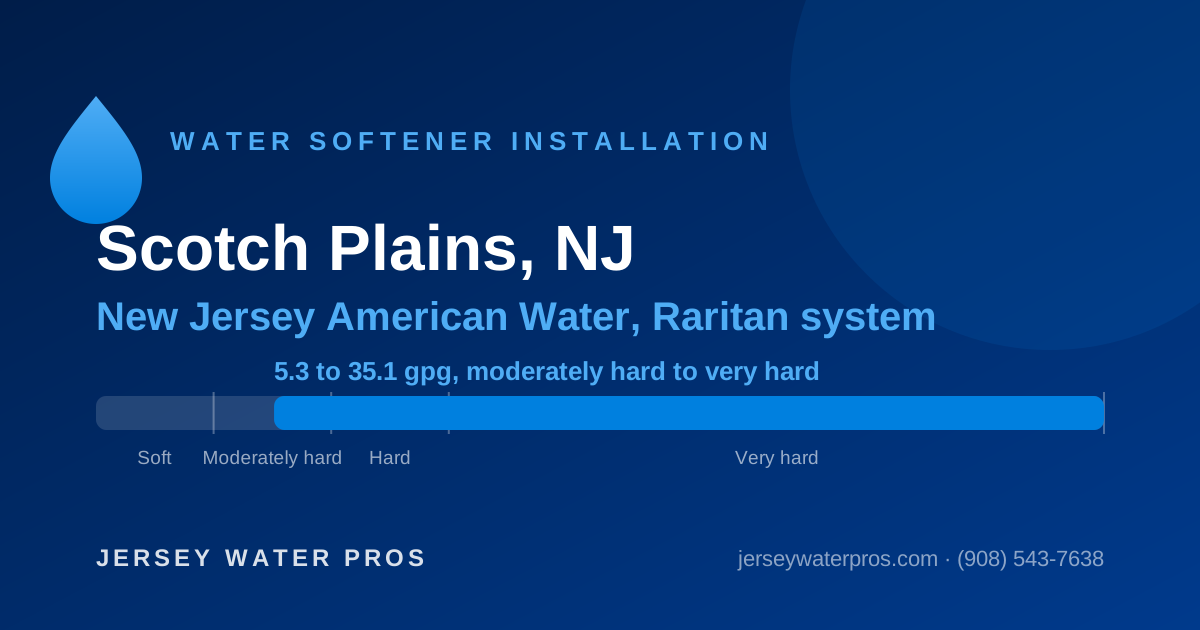
5.3 to 35.1 grains per gallon, moderately hard to very hard
County
Union County
Water softener installation in Scotch Plains, NJ starts with the widest hardness spread of any town we serve. New Jersey American Water's sheet for this part of the Raritan system lists 90 to 600 mg/L, roughly 5 to 35 grains per gallon, because the system blends river water with dozens of wells and different blends reach different blocks. The right softener at one Scotch Plains address is the wrong one a mile away. This page covers how installs work in the township, what that range means day to day, whole house filtration, and how cost takes shape ahead of a free quote.
Scotch Plains water
What Scotch Plains homeowners are dealing with
Scotch Plains gets its water from New Jersey American Water's Raritan system, the former Elizabethtown Water network. The township's website posts New Jersey American Water notices for residents, and the Jersey WaterCheck database lists Scotch Plains Township among the 46 municipalities the system serves. Per the utility's typical water quality sheet for this part of the system (Raritan System 3, which covers Scotch Plains 07076), source water comes from seven intakes on the Raritan River, Millstone River, and Delaware & Raritan Canal plus roughly 98 wells in the Brunswick, Passaic, Stockton, Glacial Drift, and Basalt aquifers.
That blend of river and well water is why hardness here covers a wide range: the utility's sheet lists 90 to 600 mg/L as CaCO3, roughly 5 to 35 grains per gallon (moderately hard to very hard on the USGS scale), depending on which sources feed your block. This part of the system disinfects with chloramine, which many homeowners notice as a chlorine-like taste. The 2025 annual report shows the Raritan system met all state and federal standards, with PFOA and PFOS detected below New Jersey's limits.
Some of the pipes under Scotch Plains are old. In 2022 the utility spent $1 million replacing roughly 2,500 feet of cast iron main installed in the 1920s, along with seven hydrants and 40 utility-owned service lines. Older mains and service lines are one reason tap-by-tap conditions vary. The utility's annual water quality report is the place to look up your area's numbers; only NJDEP-certified lab results are official, and we can help arrange a lab test. If you are weighing treatment options, Jersey Water Pros offers a free in-home estimate.
Hardness that varies widely by neighborhood
Scotch Plains (ZIP 07076) is listed on New Jersey American Water's typical water quality sheet for Raritan System 3, which shows total hardness of 90 to 600 mg/L as CaCO3, roughly 5 to 35 grains per gallon (the utility's sheet prints it as 3 to 35). The range is wide because this part of the system blends river water with water from roughly 98 wells, so well-fed neighborhoods can run much harder than river-fed ones. Even the low end of that range builds scale in water heaters and on fixtures over time.
Aging mains, some dating to the 1920s
In 2022, New Jersey American Water invested $1 million to replace about 2,500 feet of 6-inch cast iron main in Scotch Plains installed in the 1920s, upgrading to 8- and 12-inch ductile iron and replacing seven hydrants and 40 utility-owned service lines along the route. The project was part of a statewide program to renew infrastructure at the end of its useful life.
PFAS detected below state limits
The Raritan system's 2025 annual report lists PFOA at up to 7 ppt (NJ MCL 14) and PFOS at up to 6 ppt (NJ MCL 13), in compliance. Homeowners who want an added margin can consider systems certified to NSF/ANSI standards for PFOA/PFOS reduction.
Lead service lines still being identified system-wide
The Raritan system's 2024 inventory reported by the Jersey WaterCheck database lists 7,449 known lead service lines and about 103,052 lines of unknown material across the system. New Jersey law requires all lead and galvanized service lines to be replaced by 2031. The system's 2025 lead sampling met compliance: 90th percentile 2 ppb, 0 of 54 homes above the action level.
Water softener installation in Scotch Plains
In Scotch Plains, the install process has one extra step at the front: establishing your actual hardness. Because this part of the Raritan system blends surface water with roughly 98 wells, the published range runs from about 5 grains per gallon to 35. We start with the utility's numbers for your area, and when a home sits where the blend is uncertain, we help arrange a test through an NJDEP-certified lab before anyone picks equipment. Sizing a softener to a guess is how homeowners end up with a unit that regenerates constantly or one that never quite keeps up.
From there the work is standard. A licensed New Jersey master plumber ties the softener into the main line after the meter, ahead of the water heater, with a bypass valve for service. Scotch Plains housing runs from older homes near the downtown to postwar and newer construction, so tie-in conditions vary. We confirm drain access, outlet location, and the condition of the pipe at the connection point during the free quote, not on install day.
A plumbing permit under New Jersey's Uniform Construction Code is required and is filed with the Township of Scotch Plains construction office. We handle the paperwork and coordinate the inspection. The physical installation typically takes a few hours to one day, and at the harder end of the township's range we spend extra time on programming and salt settings, because a system working at 25 or 30 grains has much less margin for sloppy setup.
Scotch Plains hard water problems we fix
What hard water does to a Scotch Plains home depends heavily on which end of the range the home sits in. Near 5 to 7 grains per gallon, the story is gradual: spotted dishes, scale creeping onto showerheads, a water heater that quietly loses efficiency year over year. Near the top of the range, water in the twenties and thirties of grains behaves differently. Kettles crust in weeks. Glass shower doors etch. Tankless water heaters throw error codes as their heat exchangers narrow, and tank heaters can lose real capacity to a layer of sediment you can hear crackling when the burner fires.
The well side of the blend is what drives the high readings. The utility's sheet for this area lists wells in several aquifers, including glacial drift and basalt formations, and groundwater generally picks up more dissolved calcium and magnesium than river water. Blocks fed mostly by well sources run harder than blocks fed mostly from the river intakes, and the mix can shift with system operations. That is why neighbors in the same township report such different water, and why we treat your address's number, not the township average, as the design input.
A correctly sized metered softener solves the full range of these problems, but sizing is where Scotch Plains punishes shortcuts. At 30 grains, a household uses up softening capacity roughly four times faster than at 7 grains, which affects resin volume, salt use, and regeneration frequency. We run that math during the free quote and size for your realistic worst number, not the brochure number.
Whole house water filtration in Scotch Plains
Hardness aside, Scotch Plains water arrives with chloramine, the disinfectant used across this part of the Raritan system. It protects the water in the pipes and leaves a taste many homeowners want gone. Whole house catalytic carbon filtration removes chloramine at the point of entry, and when a softener is part of the plan, carbon belongs upstream of it, because disinfectants shorten the life of softening resin. In a township where some homes need large softeners, protecting that resin investment matters more, not less.
The system's 2025 annual report lists PFOA at up to 7 ppt and PFOS at up to 6 ppt, below New Jersey's limits of 14 and 13 ppt. For homeowners who want a further margin, the credible route is equipment certified to NSF/ANSI standards for PFOA and PFOS reduction, whether whole house or a reverse osmosis system at the kitchen sink. Ask for the certification listing, not just the claim.
Lead across the Raritan system is a service line question, with thousands of lead and unknown-material lines still being identified and a state deadline to replace them by 2031. The system's latest lead sampling met the compliance standard. Until the line to your own home is confirmed, a drinking-tap filter certified to NSF/ANSI 53 for lead reduction is a sensible interim step. The utility's annual water quality report carries your area's published numbers, and an NJDEP-certified lab test, which we can help arrange, is the official answer for your own tap.
What water treatment costs in Scotch Plains
Scotch Plains is the clearest example we serve of why honest water treatment pricing cannot come from a chart. A home at 6 grains per gallon and a home at 30 grains both need a softener, but not the same softener: capacity, resin volume, and sometimes a twin-tank design that regenerates one tank while the other works all scale with the hardness number. Equipment for the top of the township's range costs more to buy and more to feed with salt, and pretending otherwise at quote time leads to disappointed homeowners a year later.
Beyond capacity, the usual drivers apply: whether carbon filtration or a reverse osmosis unit joins the softener, the condition and location of the tie-in point, drain and outlet access, and permit fees, which the Township of Scotch Plains sets and which pass through at cost. We do not run countertop water demonstrations as a sales tactic. The utility publishes this area's numbers, and official results for a single tap come from an NJDEP-certified lab, which we can help arrange.
The free quote is the sorting mechanism. A licensed NJ master plumber visits, reviews the published numbers for your block, inspects the mechanical space, and prices the system your water actually requires, itemized across equipment, labor, and permits. There is no obligation either way, and you keep the numbers even if you never call us back.
What we install in Scotch Plains
Jersey Water Pros is based in Summit and installs across Union County, with every job performed by a licensed NJ master plumber.
Water quality varies by street and season. Only a NJDEP-certified lab can produce official results for your own tap.
FAQ
Scotch Plains water questions
How hard is the water in Scotch Plains?
New Jersey American Water's typical water quality sheet for Raritan System 3, which lists Scotch Plains ZIP 07076, shows total hardness of 90 to 600 mg/L as CaCO3, roughly 5 to 35 grains per gallon (the sheet prints it as 3 to 35). That spans moderately hard to very hard on the USGS scale. The range is wide because this part of the system mixes river water with well water, so to learn your own number, check the utility's annual water quality report or have your water tested by a NJDEP-certified lab, which we can help arrange.
Who supplies water to Scotch Plains?
Scotch Plains Township is served by New Jersey American Water's Raritan system, the former Elizabethtown Water network. The township's website posts New Jersey American Water notices for residents, and the Jersey WaterCheck database lists Scotch Plains among the system's 46 municipalities. Per the utility's sheet for this area, source water comes from river and canal intakes plus wells in several aquifers.
Does Scotch Plains tap water contain PFAS?
The Raritan system's 2025 annual water quality report lists PFOA detections up to 7 ppt against New Jersey's limit of 14, and PFOS up to 6 ppt against a limit of 13, in compliance. Homeowners who want an extra margin can consider treatment systems certified to NSF/ANSI standards for reduction of PFOA and PFOS.
Do I need a permit to install a water softener in Scotch Plains?
Yes. Tying a softener into your supply line is plumbing work that requires a permit under New Jersey's Uniform Construction Code, filed with the Township of Scotch Plains construction office. Jersey Water Pros handles the filing and inspection coordination, and the installation is performed by a licensed NJ master plumber as the code requires.
How long does water softener installation take in Scotch Plains?
The physical install typically takes a few hours to one day. The permit and township inspection add calendar time around it, and in some Scotch Plains homes we add a sizing step first: because hardness in this part of the Raritan system runs roughly 5 to 35 grains per gallon depending on the blend of river and well water reaching your block, confirming your number through the utility's published data or an NJDEP-certified lab test, which we can help arrange, can add a few days but prevents an undersized system.
Which water softener does Scotch Plains hard water need?
It depends entirely on where your address falls in the published 5 to 35 grains per gallon range. Homes at the low end do well with a standard metered softener. Homes at the harder, well-fed end need substantially more capacity, and sometimes a twin-tank design that keeps soft water flowing while one tank regenerates. Chloramine in the supply also makes carbon filtration ahead of the softener worth discussing. We size from your block's actual number during the free quote.
Service area
Where we work in Scotch Plains
We install water softeners and whole house filtration across Scotch Plains and the surrounding Union County towns.
Ready to fix your water in Scotch Plains?
Get a straight written quote from a local pro. If your water's fine, we'll tell you that too.