Water Softener Installation in Springfield, NJ
Softeners, whole house filtration, and licensed plumber installs for Springfield homes, matched to what’s actually in Springfield’s water.
Water source
New Jersey American Water, Short Hills system, Springfield zone (PWSID NJ0712001)
Typical hardness
14 to 17.1 grains per gallon, very hard
County
Union County
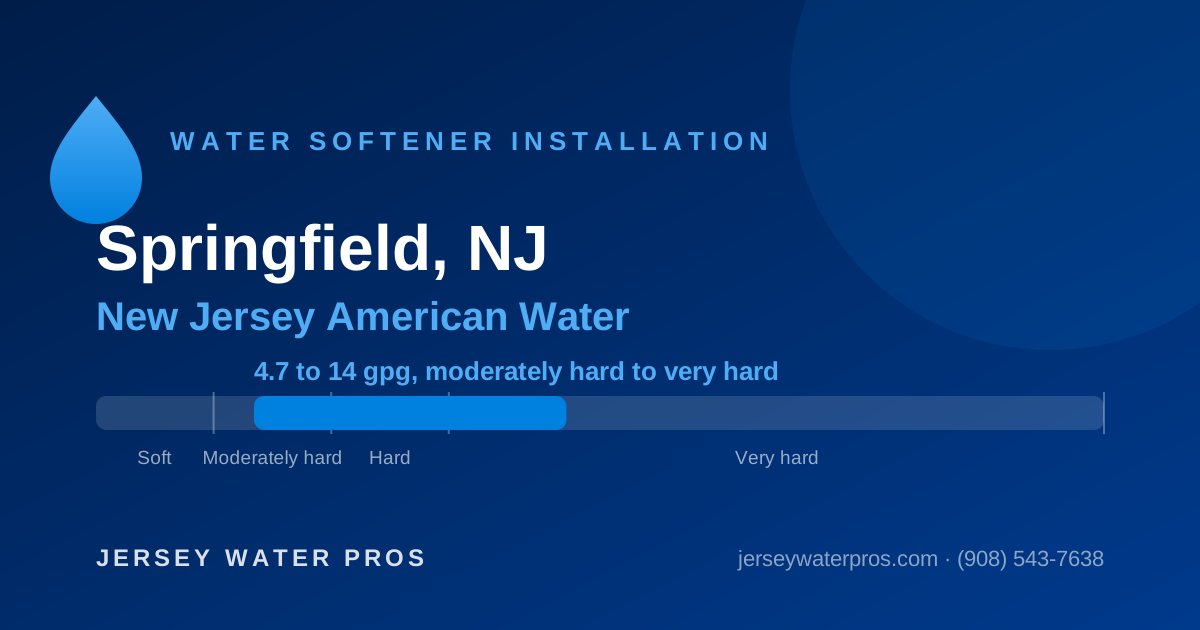
Water softener installation in Springfield, NJ is sized against one of the widest hardness spreads in the area: the utility's typical figures for the Short Hills system run 4.7 to 14 grains per gallon, and recent sampling has measured points near 20 grains. This page explains how the installation works in Springfield homes, which hard water and staining problems it solves, where whole house water filtration fits alongside softening, and how the free quote turns the township's wide range into a firm number for your house.
Springfield water
What Springfield homeowners are dealing with
Springfield's taps are supplied by New Jersey American Water's Short Hills system (PWS ID NJ0712001), the same system serving neighboring Millburn and Short Hills. Water comes from the Canoe Brook Treatment Plant on the Passaic River and Canoe Brook, local wells in the Brunswick aquifer, and purchased supplies from neighboring systems. The Short Hills Well Field sits close to home for Springfield residents: when its disinfection equipment malfunctioned in May 2025, the township posted the utility's notice with a street-by-street list of affected Springfield addresses.
On the day-to-day side, hardness is the thing most Springfield homeowners actually feel. The utility's typical figures run 4.7 to 14.0 grains per gallon, and the 2025 annual report measured up to 342 ppm, about 20 grains, at some points. That range explains spotted glassware, crusted showerheads, and shortened water heater life at the harder end. The report also lists sodium up to 139 ppm and manganese detections above the secondary limit at some sampling points.
The utility's annual water quality report shows the system-wide numbers, and only NJDEP-certified laboratory results are official for your own tap; we can help arrange that testing. To work out where your block falls in that wide range and whether a softener or carbon filtration makes sense, Jersey Water Pros offers a free in-home estimate.
Hard water and scale
Springfield has its own typical water quality sheet, and it is the hardest one New Jersey American Water publishes for this area. The sheet naming Springfield alone, fed by three wells in the Brunswick aquifer, lists hardness of 240 to 293 mg/L, which is 14.0 to 17.1 grains per gallon. That is very hard across the entire published range. The Summit zone sheet is often quoted as though it covered the whole Short Hills system, and it does not, so figures near 80 to 240 mg/L understate what Springfield actually receives. The system's 2025 annual report lists measured hardness from 52 to 342 ppm across all of Short Hills, based on 2024 sampling.
May 2025 disinfection malfunction at the Short Hills Well Field
The township posted a public notice that on May 2, 2025, the NJ American Water Short Hills Well Field experienced a malfunction in its disinfection equipment and failed to maintain required disinfectant levels. Specific streets in Springfield and Millburn/Short Hills were affected. The utility reported no evidence of contamination in its source water, no boil-water order was needed, and the facility returned to service May 19, 2025 with added safeguards.
PFAS detected below current NJ limits
The Short Hills system's 2025 report lists PFOA at a highest running annual average of 9 ppt (ND to 11 ppt) against New Jersey's 14 ppt MCL and PFOS at 5 ppt against 13 ppt. The system meets current state limits. Federal limits for PFOA and PFOS carry an April 2029 compliance deadline, though EPA has proposed allowing systems to request an extension to 2031. Under 2023 federal UCMR5 monitoring, individual PFOA samples in the system ranged from ND to 88 ppt, with an average of 2 ppt.
Sodium and manganese above secondary limits at times
The 2025 report lists sodium from 5 to 139 ppm against a 50 ppm recommended upper limit (the report notes this may be of concern to individuals on sodium-restricted diets) and manganese detections up to 2,464 ppb against a 50 ppb secondary limit at some points. Secondary limits address aesthetic issues like staining rather than safety.
Water softener installation in Springfield
A Springfield water softener installation begins at the water meter, which in many Springfield homes sits in the basement near the water heater. The softener ties in after the meter and before the heater so every hot and cold line downstream carries treated water. The regeneration cycle needs a drain and the control valve needs an outlet; both are usually within reach in a typical basement, and where they are not, we plan the routing during the quote visit rather than improvising on install day.
Springfield's housing stock spans generations, and the plumbing inside spans generations too. Older homes sometimes have galvanized interior pipe near the tie-in point, which we evaluate before cutting in, since it can be near the end of its life. None of this changes the fundamentals; it changes the prep.
Permits are part of the job. Plumbing alterations in New Jersey generally require a permit under the Uniform Construction Code, filed with the township's construction office, and we prepare and file it for you. A licensed New Jersey master plumber performs the installation, the work at a typical single-family home takes one day, and permit review plus the inspection visit add township-paced time around it. We set the regeneration schedule to your measured hardness before we leave, which matters in a town where the range is this wide.
Springfield hard water problems we fix
The published typical hardness for the system serving Springfield runs 80 to 240 mg/L, about 4.7 to 14 grains per gallon, and the latest annual report recorded sampling points as high as 342 ppm, roughly 20 grains. Water at the upper reaches of that range is very hard by any standard, and it shows up in the ways Springfield homeowners describe to us:
- Water heaters that underperform and die young. Scale builds fastest in hot water, insulating the burner or element.
- White crust on faucets, showerheads, and glass shower doors that returns within weeks of cleaning.
- Spotted glassware and dishes straight out of the dishwasher.
- Laundry that feels stiff and detergent that never quite lathers.
Springfield adds a second mineral problem the hardness number does not capture: manganese. The system's latest report lists detections up to 2,464 ppb at some sampling points against a 50 ppb secondary standard, a limit that addresses aesthetic problems like staining rather than safety. Manganese can leave dark gray or black marks on fixtures and laundry. Softeners can pick up small amounts of dissolved manganese, but levels like the high readings in the report call for dedicated filtration, which is a design decision, not an upsell. Because both hardness and manganese vary by street and season here, we size equipment from your home's measured water, starting from the utility's annual water quality report and, when it matters, a lab test we help arrange through an NJDEP-certified lab.
Whole house water filtration in Springfield
Whole house water filtration in Springfield usually starts with taste and finishes with peace of mind. The system serving the township carries a disinfectant residual to keep water safe in the mains, and that residual is what many people taste at the tap. Whole house carbon filtration reduces it at the point of entry, so showers, ice, coffee, and cooking water all improve at once rather than one faucet at a time.
The documented record here gives filtration decisions real context. The system's latest report lists PFOA at a highest running annual average of 9 ppt and PFOS at 5 ppt, both below New Jersey's current limits. Federal monitoring in 2023 recorded individual PFOA samples in the system ranging as high as 88 ppt, with an average of 2 ppt, and the system meets current standards. For households that read those numbers and want a wider margin than compliance provides, the credible path is equipment independently certified to NSF/ANSI standards for PFOA and PFOS reduction, installed either at the whole house level or at the kitchen tap.
Sodium is the quieter line in the report: 5 to 139 ppm, with the report noting the high end may concern people on sodium-restricted diets. A reverse osmosis drinking water system at the sink addresses that, and it pairs naturally with a softener. We treat filtration as a design question answered by your water's documented numbers, not a package pulled off a shelf, and the free quote covers the whole design.
What water treatment costs in Springfield
Honest pricing for water treatment in Springfield depends on which of the town's water problems your house actually has, so we quote after seeing the house rather than publishing numbers that fit nobody. The drivers:
- Where your water falls in the range. A home near 5 grains needs a different softener than one near the 14 grain top of the typical range, let alone the 20 grain sampling points in the latest report.
- Whether manganese is part of the picture. Staining that hardness alone does not explain can mean an added filtration stage.
- Scope. Softener alone, whole house carbon, a certified drinking water system, or a combination.
- Site and permit specifics. Plumbing access, drain location, and township permit fees passed through at cost.
Operating costs stay modest when equipment is sized right: a demand-initiated softener regenerates on actual water use, so salt and rinse water track your household, not a timer.
The free quote is a visit, an inspection of your plumbing and mechanicals, a review of your water's documented numbers, and a written price covering equipment, installation by a licensed New Jersey master plumber, permit handling, and startup. If lab data would change the design, we say so and help arrange testing through an NJDEP-certified lab first. No charge, no obligation, and we are based nearby in Summit, so service after the install is local.
What we install in Springfield
Jersey Water Pros is based in Summit and installs across Union County, with every job performed by a licensed NJ master plumber.
Water quality varies by street and season. Only a NJDEP-certified lab can produce official results for your own tap.
FAQ
Springfield water questions
Who supplies Springfield's drinking water?
New Jersey American Water's Short Hills system, which blends water from the Canoe Brook Treatment Plant, local wells including the Short Hills Well Field, and purchased supplies. The township posts the utility's water notices on its website, including the May 2025 treatment notice.
How hard is the water in Springfield?
The utility's typical figures for the Short Hills system are 80 to 240 mg/L, about 4.7 to 14.0 grains per gallon, and its 2025 report measured points as high as 342 ppm, about 20 grains. Homes at the harder end of that range typically benefit from a softener. The utility's annual water quality report, or an NJDEP-certified lab test we can help arrange, will pin down your street's actual number.
What happened with Springfield's water in May 2025?
On May 2, 2025, disinfection equipment at the Short Hills Well Field malfunctioned and the station failed to maintain required disinfectant levels, triggering a violation notice to customers on specific Springfield and Millburn/Short Hills streets. The utility reported no evidence of contamination in its source water, no boil-water order was issued, and the station returned to service on May 19, 2025 with additional alarms and safeguards.
Do I need a permit to install a water softener in Springfield?
Generally yes. A softener tie-in is a plumbing alteration under New Jersey's Uniform Construction Code, permitted through the township's construction office. We prepare and file the permit as part of the job, and a licensed New Jersey master plumber does the work so the inspection goes smoothly.
How long does a water softener installation take in Springfield?
One day of onsite work for a typical single-family home. Older houses with galvanized pipe near the tie-in can take longer if pipe replacement is needed. Permit review and inspection scheduling add township-paced time around the install, and your written quote includes the full expected timeline.
Which water treatment system does Springfield water need?
It depends on your street's numbers. With typical hardness of 4.7 to 14 grains per gallon and sampling points near 20 grains, most homes benefit from a properly sized softener. Homes with dark staining may need manganese-focused filtration, since the latest report shows detections well above the secondary standard at some points. Households watching sodium sometimes add a reverse osmosis tap. We start from the utility's annual water quality report and, when needed, an NJDEP-certified lab test we help arrange.
Service area
Where we work in Springfield
We install water softeners and whole house filtration across Springfield and the surrounding Union County towns.
Ready to fix your water in Springfield?
Get a straight written quote from a local pro. If your water's fine, we'll tell you that too.