Water Softener Installation in Clark, NJ
Softeners, whole house filtration, and licensed plumber installs for Clark homes, matched to what’s actually in Clark’s water.
Water source
New Jersey American Water, Raritan System 1 (PWSID NJ2004002)
Typical hardness
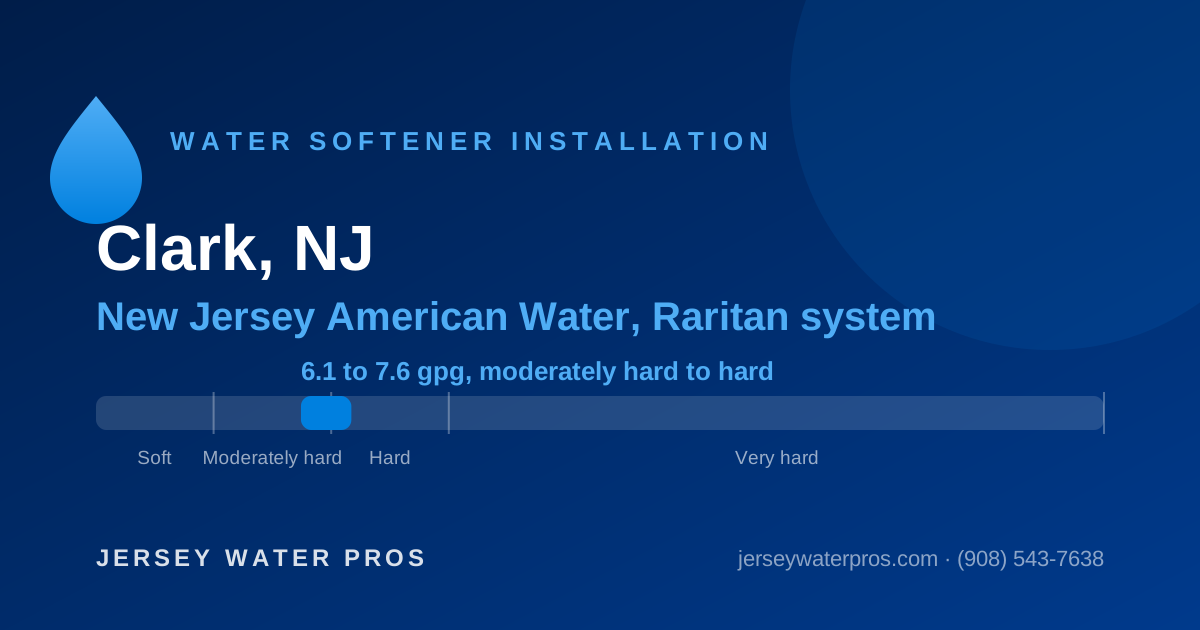
6.1 to 7.6 grains per gallon, moderately hard to hard
County
Union County
Water softener installation in Clark, NJ works from one of the steadiest numbers we deal with. New Jersey American Water's typical water quality sheet for this part of the Raritan system lists Clark 07066 and puts total hardness at 104 to 130 mg/L as CaCO3, about 6.1 to 7.6 grains per gallon, moderately hard to hard and consistent enough to size equipment around. This page covers the rest of the decision for Clark homeowners: how an install actually goes in the township's postwar houses, which hard water problems a softener solves, where whole house filtration fits, and how cost comes together before a free quote from a licensed NJ master plumber.
Clark water
What Clark homeowners are dealing with
Clark's taps are fed by New Jersey American Water's Raritan system, PWSID NJ2004002. The utility's typical water quality sheet for Raritan System 1 lists Clark 07066 alongside Cranford, Garwood, Linden, Roselle, Roselle Park, Westfield, and several Somerset and Middlesex County towns, and describes source water coming from seven intakes on the Raritan River, Millstone River, and Delaware & Raritan Canal. Unlike the neighboring Raritan System 3 zone, no wells are listed for this zone, which is why Clark's numbers hold so steady. The Jersey WaterCheck database lists Clark Township among the municipalities the system serves, with roughly 736,800 people supplied.
The numbers on that sheet are the most predictable in our service area. Total hardness runs 104 to 130 mg/L as CaCO3, about 6.1 to 7.6 grains per gallon, which the utility rounds to 6 to 7. On the USGS scale that is moderately hard to hard. Sodium runs 31 to 36 mg/L against a 50 mg/L secondary standard, iron and manganese come back not detected, and disinfection is by chloramine at monthly average residuals of 0.7 to 1.2 mg/L in the distribution pipes. That chloramine is the chlorine-like taste many Clark residents describe, and it lingered unusually in December 2024, when alpha-pinene leaked into a Raritan River tributary in Branchburg and gave the whole system a taste and odor problem while the utility reported the finished water still met primary standards.
The lead service line program has now reached Clark directly. In June 2026 the utility announced that its contractor CDM Smith would begin knocking on doors in the township to confirm what each customer-owned service line is made of, under a 2021 state law requiring lead and galvanized lines to be removed by 2031. Inspections are free, appointments can be scheduled online, and residents can also self identify their line material through the utility's short survey. To see your own numbers, start with the utility's annual water quality report. Only NJDEP-certified lab results are official for a single tap, and we can help arrange that testing. If you are weighing treatment, Jersey Water Pros offers a free quote.
Hardness and scale
New Jersey American Water's typical water quality sheet for Raritan System 1, which lists Clark 07066 by name, shows total hardness of 104 to 130 mg/L as CaCO3, about 6.1 to 7.6 grains per gallon, which the utility rounds to 6 to 7 grains on the same page. That is steady, predictable, and enough to build scale in water heaters, crust showerheads, and spot glassware over time. The same sheet lists iron and manganese as not detected, so staining is not the issue here that it is in some neighboring towns.
Lead service line assessments underway in Clark
On June 19, 2026 New Jersey American Water announced that its contractor CDM Smith would begin door-to-door outreach in Clark the following week, conducting service line material assessments and inspections moving through the community over the next several weeks. The work supports a 2021 state law requiring water providers to identify and replace both the utility-owned and customer-owned portions of lead and galvanized steel service lines by 2031. The utility stresses that all assessments are conducted at no cost, that CDM Smith staff carry official company photo ID badges and wear logoed high-visibility vests, and that they never request payment, fees, or personal financial information.
Chloramine taste and the December 2024 taste and odor event
The part of the Raritan system serving Clark disinfects with chloramines, at monthly average residuals of 0.7 to 1.2 mg/L in the distribution system per the utility's sheet. On December 16, 2024 a leak of alpha-pinene, described by the utility as a commonly used fragrance and food additive, from a repackaging facility in Branchburg entered a tributary of the Raritan River and caused taste and odor complaints across the system beginning the evening of December 17. The utility reported that its samples continued to meet primary state and federal drinking water standards, and said that as of January 9, 2025 there should be minimal if any customers still observing it.
PFAS detected below state limits
The Raritan system's 2025 annual water quality report lists PFOA at up to 7 ppt against New Jersey's 14 ppt MCL and PFOS at up to 6 ppt against 13 ppt, both in compliance, with the UCMR5 hazard index calculation for the four-PFAS mixture below 1. Lead sampling in the same report met the compliance standard with a 90th percentile of 2 ppb, a range of non-detect to 15 ppb, and none of the 54 sampled homes above the 15 ppb action level. Homeowners who want an added margin can consider systems certified to NSF/ANSI 53 for reduction of PFOA and PFOS.
Water softener installation in Clark
A Clark water softener installation starts with a free quote visit from a licensed New Jersey master plumber, not a sales presentation. We find where the service line enters the house, confirm there is a drain and a standard outlet within reach, and look at the condition of the pipe and shutoff valve near the meter. The softener ties into the main line after the meter and ahead of the water heater, with a bypass valve so the unit can be serviced without shutting off the house. Outdoor spigots normally stay on untreated water so you are not softening the lawn.
Clark's housing shapes the details. Much of the township was built out in the postwar decades, which means ranches and split levels where the mechanical space sits in a compact utility room, a garage corner, or a finished lower level that nobody wants opened up. Those layouts are workable, but they need to be measured before equipment is ordered, and that is exactly what the quote visit is for.
Because the work opens your supply line, it requires a plumbing permit under New Jersey's Uniform Construction Code, filed with the Township of Clark construction office. We prepare and file that paperwork, and the installing plumber is the licensed NJ master plumber state rules require. The physical work usually runs a few hours to one day: setting the unit, cutting in the bypass, connecting the drain line, and programming the control valve to Clark's published hardness. The township inspection follows, and we walk you through salt, settings, and maintenance before we leave.
Clark hard water problems we fix
At 104 to 130 mg/L as CaCO3, about 6.1 to 7.6 grains per gallon, Clark's water is hard enough to cause steady, low-grade damage without ever announcing itself. Calcium and magnesium come out of solution wherever water is heated or left to dry, which is why the showerhead crusts over, the glass shower door films up two days after cleaning, and dishes come out of the dishwasher spotted.
The expensive part happens out of sight. Scale settles in the bottom of a tank water heater and coats electric elements, so the heater runs longer for the same hot water and gives up years early. Tankless units collect the same deposits inside the heat exchanger, where a thin layer is enough to trigger error codes. Dishwashers, washing machines, and ice makers all push water through small valves and passages that hard water narrows over time.
Hard water also fights soap. Minerals bind detergent before it can lift anything, so laundry needs more product and still feels stiff, and skin can feel dry after a shower even with the soap you have always used. Most Clark households have simply adjusted, because 6 to 7 grains causes all of it without being dramatic enough to force a decision.
A metered water softener removes the calcium and magnesium at the point of entry, so no new scale forms past that point. Clark's hardness is steady, which makes sizing straightforward: your grains per gallon multiplied by the gallons your household uses each day sets the capacity needed between regenerations. We run those numbers with you during the free quote and show the math.
Whole house water filtration in Clark
Softening handles minerals. It does not touch taste, and taste is the second thing Clark homeowners ask about. This part of the Raritan system disinfects with chloramine, and the utility's sheet for the area lists monthly average residuals of 0.7 to 1.2 mg/L in the distribution pipes. Chloramine is more stable than plain chlorine, which is good for the mains and harder to strip at the tap. Whole house filtration with catalytic carbon is built for that job, and putting carbon ahead of a softener also protects the softening resin, which disinfectants wear down over time.
December 2024 made the case for carbon a different way. A leak of alpha-pinene from a repackaging facility in Branchburg reached a tributary of the Raritan River on December 16 and left a taste and odor problem across the system. The utility reported that its samples continued to meet primary state and federal drinking water standards throughout, and by January 9, 2025 said few if any customers should still notice it. A whole house carbon system gives your home a buffer against whatever the river carries next.
On contaminants, the system's 2025 annual report lists PFOA at up to 7 ppt against New Jersey's 14 ppt MCL and PFOS at up to 6 ppt against 13 ppt, both in compliance. If you want a margin below what the state requires, look for equipment certified to NSF/ANSI 53 for reduction of PFOA and PFOS, or a reverse osmosis system certified to NSF/ANSI 58 at the kitchen sink. For lead, a drinking tap filter certified to NSF/ANSI 53 for lead reduction is a reasonable step while your service line material is being confirmed.
What water treatment costs in Clark
We do not publish a flat price for water treatment in Clark, and any company that quotes one before seeing your home is guessing. Cost comes down to a short list.
- Equipment and capacity. A softener on its own, a softener with whole house carbon, or a reverse osmosis unit at the sink are different projects, sized to your household at Clark's 6.1 to 7.6 grains per gallon.
- Install conditions. How far the tie-in point sits from a drain and outlet, and whether the pipe or shutoff near the meter needs attention while it is open.
- Permit fees. Set by the Township of Clark and passed through at cost.
One thing we do not do is offer water testing of any kind. Clark's hardness and disinfectant levels are already published by the utility in its annual water quality report, and questions about lead or PFAS at your own tap belong with an NJDEP-certified lab, which we can help arrange. Quoting from real numbers keeps the recommendation honest, and New Jersey's consumer protection law is one more reason we work that way.
The free quote is simple. A licensed NJ master plumber visits, inspects the tie-in and drain options, asks what you actually want to fix, whether that is scale, taste, or both, and leaves a written quote itemizing equipment, labor, and permits. There is no obligation, the visit usually takes under an hour, and we are based in Summit, so service after the install stays local.
What we install in Clark
Jersey Water Pros is based in Summit and installs across Union County, with every job performed by a licensed NJ master plumber.
Water quality varies by street and season. Only a NJDEP-certified lab can produce official results for your own tap.
FAQ
Clark water questions
How hard is the water in Clark, NJ?
New Jersey American Water's typical water quality sheet for Raritan System 1, which lists Clark 07066, shows total hardness of 104 to 130 mg/L as CaCO3, about 6.1 to 7.6 grains per gallon, which the utility rounds to 6 to 7 on the same page. That is moderately hard to hard on the USGS scale, steady enough to plan equipment around, and enough to build scale in water heaters and leave spots on dishes.
Why is New Jersey American Water knocking on doors in Clark?
On June 19, 2026 the utility announced that its contractor CDM Smith would begin door-to-door outreach in Clark the following week to assess and inspect water service line materials, moving through the community over the next several weeks. It is part of the statewide Lead Service Line Replacement Program, which follows a 2021 state law requiring both the utility-owned and customer-owned portions of lead and galvanized steel service lines to be replaced by 2031. Inspections are conducted at no cost, staff carry official company photo ID badges and wear logoed high-visibility vests, and they never request payment, fees, or personal financial information. Residents can also schedule an inspection online or self identify their line material through the utility's short survey.
Who supplies Clark's water and where does it come from?
Clark is served by New Jersey American Water's Raritan system, PWSID NJ2004002. Per the utility's sheet for this service zone, source water comes from seven intakes on the Raritan River, Millstone River, and the Delaware & Raritan Canal, with no wells listed for the zone. The system's 2025 annual water quality report shows it met state and federal drinking water standards, with PFOA and PFOS detected below New Jersey's limits.
Do I need a permit to install a water softener in Clark?
Yes. A new softener opens your home's supply line, which is plumbing work requiring a permit under New Jersey's Uniform Construction Code, filed with the Township of Clark construction office. Jersey Water Pros prepares and files the paperwork as part of the job, a licensed NJ master plumber performs the installation as state rules require, and the township inspects the finished work.
How long does a water softener installation take in Clark?
Plan on a few hours to one day for the physical work: setting the unit, cutting in the bypass, connecting the drain line, and programming the control valve for Clark's published 6.1 to 7.6 grains per gallon. Permit filing and the township inspection add calendar days around the install. In split levels and ranches where the mechanical space is tight, we confirm clearances during the quote visit so install day stays on schedule.
Which water softener is right for Clark's water?
Clark's hardness is steady and moderate, so most homes are well served by a standard metered softener sized to the household: grains per gallon multiplied by daily water use sets the capacity between regenerations. Because this part of the Raritan system disinfects with chloramine, many homeowners pair the softener with catalytic carbon filtration, both for taste and to protect the softening resin, and some add reverse osmosis at the kitchen sink for drinking water. The free quote sorts out which pieces your home actually needs.
Service area
Where we work in Clark
We install water softeners and whole house filtration across Clark and the surrounding Union County towns.
Ready to fix your water in Clark?
Get a straight written quote from a local pro. If your water's fine, we'll tell you that too.