Water Softener Installation in Montclair, NJ
Softeners, whole house filtration, and licensed plumber installs for Montclair homes, matched to what’s actually in Montclair’s water.
Water source
Montclair Water Bureau (PWSID NJ0713001), supplied mainly by the North Jersey District Water Supply Commission
Typical hardness
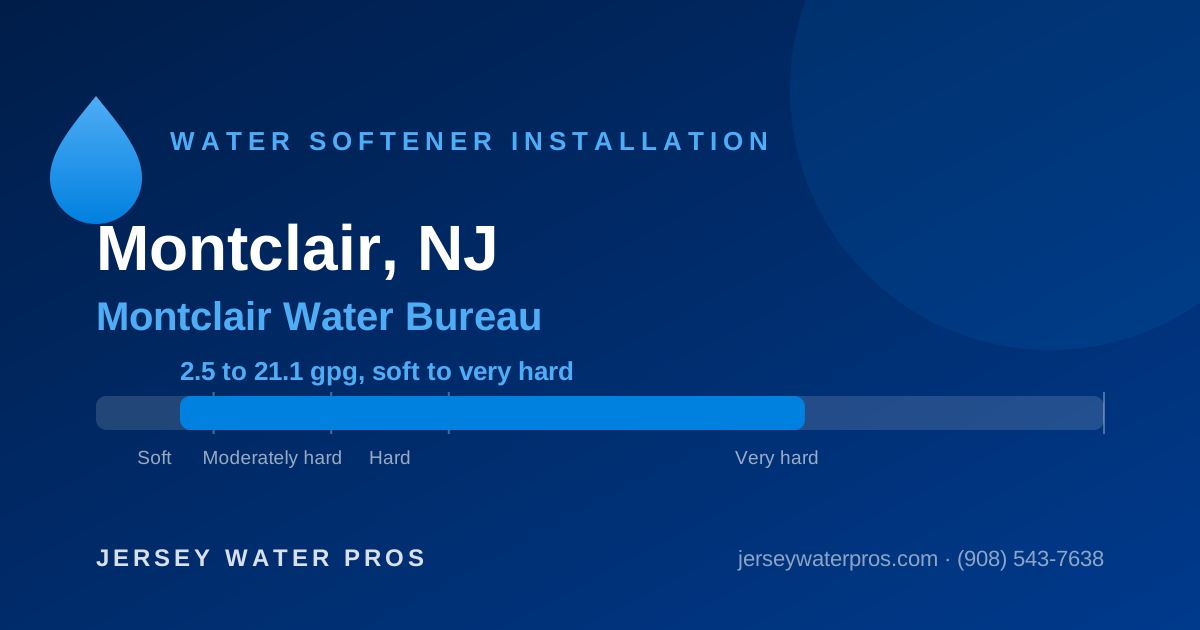
2.5 to 21.1 grains per gallon, soft to very hard
County
Essex County
Water softener installation in Montclair, NJ has one complication no neighboring town shares: the township runs two water supplies that are nothing alike. Purchased Wanaque water tested at 42 ppm of hardness, about 2.5 grains per gallon and soft, while Montclair's own municipal wells tested at 342 to 360 ppm, roughly 20 to 21 grains per gallon and very hard. With one well in each of three pressure zones, the right equipment on one street can be wrong on another. This page walks through how an install works in the township, what that split means day to day, where whole house filtration fits, and how cost takes shape before your free quote from our licensed NJ master plumbers.
Montclair water
What Montclair homeowners are dealing with
Montclair runs its own water utility, the Montclair Water Bureau (PWS ID NJ0713001), but most of what comes out of the tap starts about twenty miles north. The township is a partner in the North Jersey District Water Supply Commission, which owns and operates the 29.6 billion gallon Wanaque Reservoir and Treatment Plant along with the 7 billion gallon Monksville Reservoir. That water is received through Montclair's Grove Street pumping station and is pumped throughout the township. The system also includes three municipal wells, one in each of Montclair's three pressure zones.
That split is the single most important thing a Montclair homeowner should know about their water, because the two supplies are nothing alike. In the hardness data published in the township's 2025 report, which comes from 2023 sampling, the purchased Wanaque supply measured 42 ppm as CaCO3, about 2.5 grains per gallon and soft by any standard. Hardness from Montclair's own wells measured 350 ppm on average with a range of 342 to 360 ppm, roughly 20 to 21 grains per gallon and very hard. The same 2023 sampling put the township's own total dissolved solids at 547 ppm, above the 500 ppm recommended upper limit, and chloride at 157 ppm against a 250 ppm limit. Neighbors on different pressure zones, or the same house at different times of year, can be dealing with genuinely different water.
The 2025 report shows no violations. PFOA was not detected in Montclair's own results and measured 4.47 ppt in the purchased supply, below New Jersey's 14 ppt limit, and the Water Bureau says Glenfield and Lorraine wells will run in 2026 with carbon absorbers while Rand well gets PFAS treatment, with no wells operating without carbon. Trihalomethanes ran to 55.3 ppb with single samples up to 77.6 ppb against an 80 ppb limit. On lead, the 90th percentile was non-detect with none of 32 sites over the action level, and the township notes lead service lines are more likely in buildings put up before 1940, with its 2026 replacement program expected at no cost to eligible homeowners. To see your own area's numbers, start with the Water Bureau's annual report; only NJDEP-certified lab results are official for your tap, and we can help arrange a lab test. Jersey Water Pros offers a free in-home estimate if you are considering treatment.
Two very different waters in one township
Montclair's 2025 water quality report publishes hardness from 2023 sampling. The purchased North Jersey District Water Supply Commission supply measured 42 ppm as CaCO3, about 2.5 grains per gallon, which is soft. The township's own municipal wells measured 350 ppm, with a range of 342 to 360 ppm, or roughly 20 to 21 grains per gallon, which is very hard on the USGS scale. Montclair has three pressure zones with one municipal well in each, so what your tap does depends on whether a well is running in your zone.
Disinfection byproducts close to the limit
The 2025 report lists trihalomethanes in Montclair's system at 55.3 ppb with individual results from 32.9 to 77.6 ppb, against an 80 ppb MCL, and 30 to 40 ppb in the purchased supply. Haloacetic acids ran to 33.5 ppb with results from 24 to 43 ppb against a 60 ppb limit. Chlorine averaged 0.89 ppm in Montclair's system with a range of 0.23 to 1.54 ppm, and 1.2 ppm in the purchased supply with a range of 0.71 to 4.39 ppm. No violations were reported for any of these.
PFOA in the purchased supply and wells being retrofitted
PFOA was not detected in Montclair's own sampling and was reported at 4.47 ppt in the North Jersey District Water Supply Commission supply, against New Jersey's 14 ppt MCL, with no violation. PFNA was not detected in either, against a 13 ppt MCL. EPA's national limit of 4.0 ppt for PFOA was finalized in April 2024 with a 2029 compliance deadline that EPA has proposed extending to 2031. The Water Bureau states that Glenfield and Lorraine wells will run in the spring and summer of 2026 with carbon absorbers, that Rand well will be updated with PFAS treatment in the near future, and that no wells will operate without carbon treatment.
Lead service lines more likely in pre-1940 buildings
Lead sampling in 2025 found a 90th percentile of non-detect in Montclair's system, with a range of non-detect to 4.23 ppb and none of the 32 sampled sites above the 15 ppb action level. The township notes that while its water mains do not contain lead, the service line running from the main to your home may be lead, especially if the building was constructed before 1940, and that galvanized and brass lines must also be replaced. Montclair runs a 2026 Lead Service Line Replacement Program that it expects to provide at no cost to eligible homeowners, and it publishes a service line inventory residents can search by address.
Water softener installation in Montclair
Every Montclair install starts by pinning down which water your house actually gets. The Water Bureau's published numbers put purchased Wanaque supply at about 2.5 grains per gallon and the township's own wells at roughly 20 to 21 grains, so we do not size equipment off a township average. We start from the bureau's annual report for your pressure zone and, when the picture is unclear, help arrange a test through an NJDEP-certified lab before anyone picks a unit.
From there the work is standard. A licensed New Jersey master plumber ties the softener into the main line after the meter and ahead of the water heater, with a bypass valve so the unit can be serviced without shutting the house down. Montclair's housing runs from large older homes on the mountain to smaller postwar houses toward the eastern edge of town, so tie-in conditions vary a great deal. We confirm drain access, outlet location, and the condition of the pipe at the connection point during the free quote.
A plumbing permit is required under New Jersey's Uniform Construction Code, because tying in a softener changes the piping arrangement rather than counting as ordinary maintenance, and it is filed with the Township of Montclair construction office. We prepare the paperwork and coordinate the inspection that follows. The physical installation normally takes a few hours to one day. In zones where a municipal well runs, we spend extra time on programming and salt settings, because a softener working at 20 grains has far less margin for a sloppy setup than one working at 3.
Montclair hard water problems we fix
Montclair homeowners compare notes and find they are describing different water. That is real. The township's report shows purchased Wanaque supply at 42 ppm of hardness and Montclair's own wells at 342 to 360 ppm. A home running mostly on reservoir water may see nothing worse than occasional spotting. A home in a zone where a municipal well is carrying the load is in very hard water territory, where kettles crust in weeks, shower glass films, and a tank water heater fills with sediment years ahead of schedule.
The well side of the supply brings more than hardness. Total dissolved solids from the township's own sources measured 547 ppm, above the 500 ppm recommended upper limit, and chloride measured 157 ppm against a 250 ppm limit. Neither is a health standard, but both shape taste and both track with the mineral heavy character of local groundwater. Homeowners often describe it as a flat or salty edge that reservoir water does not have.
A properly sized metered softener removes the calcium and magnesium at the point of entry and stops new scale from forming, and in Montclair the sizing question is the whole game. A household at 20 grains per gallon burns through softening capacity roughly seven times faster than the same household at 3 grains, which changes resin volume, salt use, and regeneration frequency. We run that math during the free quote and size for your realistic worst case, not the friendliest number in the report.
Whole house water filtration in Montclair
Taste is the most common reason Montclair homeowners add whole house filtration. Chlorine averaged 0.89 ppm in Montclair's system with a range of 0.23 to 1.54 ppm, and 1.2 ppm in the purchased supply with a range as high as 4.39 ppm, so the strength of that taste varies by zone and by day. Whole house carbon filtration removes chlorine taste and odor at the point of entry, and carbon placed ahead of a softener also protects the softening resin, which disinfectants degrade over time.
Carbon does a second job here. Trihalomethanes, a byproduct of chlorination, ran to 55.3 ppb with single samples up to 77.6 ppb against an 80 ppb limit, and haloacetic acids ran to 43 ppb against a 60 ppb limit. Both were in compliance with no violations, and both are the kind of number that makes homeowners want a margin at their own tap.
On PFAS, PFOA was not detected in Montclair's own results and measured 4.47 ppt in the purchased supply against New Jersey's 14 ppt limit. EPA's national limit of 4.0 ppt was finalized in April 2024 with a 2029 compliance deadline that EPA has proposed extending to 2031, and the Water Bureau says Glenfield and Lorraine wells will run in 2026 with carbon absorbers while Rand well is updated with PFAS treatment. Homeowners who want their own barrier should look for equipment certified to NSF/ANSI 53 or NSF/ANSI 58 for reduction of PFOA and PFOS. For lead, which here is about service lines in pre-1940 buildings, a drinking tap filter certified to NSF/ANSI 53 for lead reduction is a sensible step while the township's inventory and replacement program work through the list.
What water treatment costs in Montclair
Cost in Montclair varies more than in most nearby towns for one reason: the water does. A home on soft reservoir water may need no softener at all, and we will tell you that. A home in a zone where a municipal well is running at 20 grains needs real capacity, and often carbon filtration alongside it. Rather than publish numbers that would be wrong for half the township, we price each home from its own water and its own basement.
The drivers are consistent: equipment type and capacity, install conditions such as the distance from the tie-in point to a drain, any older plumbing that needs attention at the connection, and permit fees, which the Township of Montclair sets and which pass through at cost. Be skeptical of a firm price quoted before anyone has seen your mechanical room, and equally skeptical of a countertop water demonstration used to close a sale. We do not do those. Hardness data is published by the Water Bureau, and questions about lead or PFAS belong with an NJDEP-certified lab, which we can help arrange.
The free quote is straightforward. A licensed NJ master plumber visits, checks your tie-in point and drain options, reviews the published numbers for your pressure zone, and gives you a written, itemized quote covering equipment, labor, and permits. There is no obligation, and the visit usually takes under an hour.
What we install in Montclair
Jersey Water Pros is based in Summit and installs across Essex County, with every job performed by a licensed NJ master plumber.
Water quality varies by street and season. Only a NJDEP-certified lab can produce official results for your own tap.
FAQ
Montclair water questions
How hard is the water in Montclair?
It depends on where your water is coming from that day. Montclair's 2025 report publishes hardness from 2023 sampling: the purchased North Jersey District Water Supply Commission supply measured 42 ppm as CaCO3, about 2.5 grains per gallon, which is soft. The township's own municipal wells measured 342 to 360 ppm, roughly 20 to 21 grains per gallon, which is very hard. With three pressure zones and one well in each, homes fed largely by well water see heavy scale while homes on Wanaque water may see almost none.
Where does Montclair's water come from?
Most of it comes from the North Jersey District Water Supply Commission, in which Montclair is a partner. The commission owns and operates the 29.6 billion gallon Wanaque Reservoir and Treatment Plant and the 7 billion gallon Monksville Reservoir, and the water is received through Montclair's Grove Street pumping station. The Montclair system also includes three municipal wells, one in each of the township's three pressure zones, which the Water Bureau says will operate only with carbon treatment.
Does Montclair have lead service lines?
Some homes do. The township says its water mains do not contain lead, but the service line running from the main to a building may be lead, galvanized, or brass, especially in buildings constructed before 1940. Montclair publishes a service line inventory that residents can look up by address, and its 2026 Lead Service Line Replacement Program is expected to be provided at no cost to eligible homeowners, though properties listed as unknown must first be verified. Lead sampling in 2025 found a 90th percentile of non-detect with none of 32 sites above the action level. Only an NJDEP-certified lab result is official for your own tap, and we can help arrange a lab test.
Do I need a permit to install a water softener in Montclair?
Yes. Tying a softener into your home's potable supply changes the piping arrangement, so it falls outside the ordinary maintenance list in New Jersey's Uniform Construction Code and requires a plumbing permit, filed with the Township of Montclair construction office. Jersey Water Pros prepares and files the paperwork, the installation is performed by a licensed NJ master plumber as the code requires, and the township inspects the completed work.
How long does a water softener installation take in Montclair?
Plan on a few hours to one day for the physical work, plus calendar time for the permit and township inspection. Montclair adds one step at the front: confirming which supply feeds your pressure zone, since published hardness runs from about 2.5 grains per gallon on purchased Wanaque water to roughly 21 grains on the township's own wells. We settle that before equipment is ordered so the system is sized once, correctly.
Which water softener is right for Montclair's water?
It depends entirely on your pressure zone. Homes running on purchased reservoir water at about 2.5 grains per gallon may need little or no softening, while homes fed by a municipal well at roughly 20 to 21 grains need a high capacity metered unit. Chlorine taste and disinfection byproducts are a separate question that whole house carbon filtration answers, and households wanting a PFAS or lead barrier should choose equipment certified to NSF/ANSI 53 or NSF/ANSI 58 for those specific reduction claims. The free quote works out which combination your house actually requires.
Service area
Where we work in Montclair
We install water softeners and whole house filtration across Montclair and the surrounding Essex County towns.
Ready to fix your water in Montclair?
Get a straight written quote from a local pro. If your water's fine, we'll tell you that too.