Water Softener Installation in Morristown, NJ
Softeners, whole house filtration, and licensed plumber installs for Morristown homes, matched to what’s actually in Morristown’s water.
Water source
Southeast Morris County Municipal Utilities Authority (PWSID NJ1424001)
Typical hardness
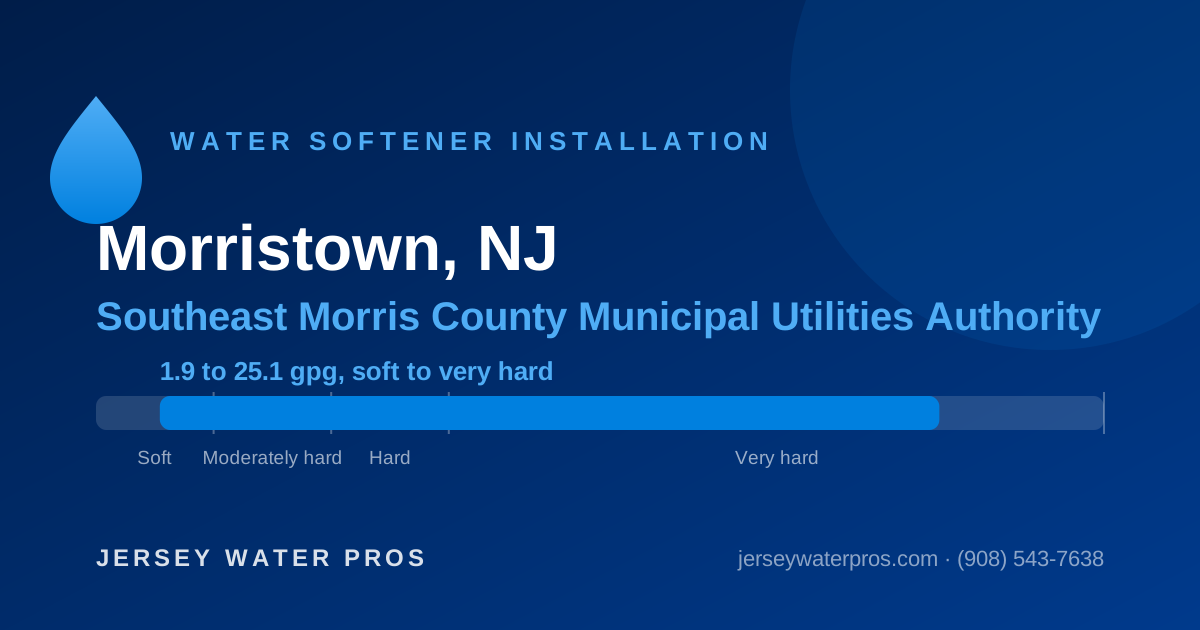
1.9 to 25.1 grains per gallon, soft to very hard
County
Morris County
Water softener installation in Morristown, NJ starts with the widest published hardness range of any town we serve. SMCMUA's own 2025 report lists 33 to 430 ppm in its sources, which the authority prints as 1.9 to 25.1 grains per gallon, and flags the 250 ppm recommended upper limit as not achieved. The authority blends Clyde Potts Reservoir water, its own wells, and purchased supply, so the right softener at one Morristown address can be the wrong one a mile away. This page covers how an install works in town, what that range means day to day, whole house filtration, and how cost comes together before your free quote from our licensed NJ master plumbers.
Morristown water
What Morristown homeowners are dealing with
Morristown does not run its own water utility. The town is one of four creating municipalities of the Southeast Morris County Municipal Utilities Authority (PWSID NJ1424001), along with the Township of Morris, the Township of Hanover, and the Borough of Morris Plains, and SMCMUA also serves customers in the Townships of Chatham, Mendham, Harding, Randolph and Parsippany-Troy Hills, plus the Borough of Florham Park, with wholesale supply to the Borough of Wharton. All told the authority serves roughly 65,000 residents and delivers about 8.8 million gallons a day on average, in excess of 15.0 million during peak demand.
The supply is a blend, which is why Morristown water is hard to describe in a single number. SMCMUA treats surface water from the Clyde Potts Reservoir using membrane filtration, granular activated carbon adsorption, corrosion control treatment and chlorine disinfection, and it draws groundwater from the glacial sand and gravel and Brunswick aquifers, with two of those groundwater sources treated for the removal of volatile organic contaminants and two treated for the removal of manganese. It also buys finished water from the Morris County MUA, whose supply originates from groundwater, and from the Passaic Valley Water Commission, whose supply is a blend of its Little Falls plant and the Wanaque plant. Hardness in SMCMUA's own sources ran 33 to 430 ppm in 2025, which the authority prints as 1.9 to 25.1 grains per gallon, and the 250 ppm recommended upper limit was not achieved.
The report is candid about the reasons. SMCMUA attributes its hardness, sodium, and total dissolved solids exceedances to sodium chloride used for de-icing roadways, and it carries a formal notice that sodium ran 19 to 74 ppm against New Jersey's 50 ppm recommended limit. PFOA came in at a 9.0 ppt running annual average with individual results up to 16.0 ppt against the state's 14 ppt MCL, in compliance on the running average basis the rule uses. Lead sampling was clean, with a 90th percentile of 1.5 ppb and none of 30 samples above the action level, though the authority's own water is listed as corrosive and the question of who pays to replace the customer-owned portion of a lead or galvanized service line is still being worked out publicly. Start with SMCMUA's annual water quality report for your area's numbers; only NJDEP-certified lab results are official for your own tap, and we can help arrange a lab test. Jersey Water Pros offers a free in-home estimate if you are weighing treatment.
Hardness above the state's recommended limit, with a very wide range
SMCMUA's 2025 water quality report lists hardness in its own sources at 33 to 430 ppm as CaCO3, which the report itself converts to 1.9 to 25.1 grains per gallon, and marks the 250 ppm recommended upper limit as not achieved. Purchased water from the Passaic Valley Water Commission's Little Falls plant and the North Jersey District Water Supply Commission's Wanaque plant tested at 42 to 242 ppm, or 2.5 to 14 grains per gallon, and did meet the limit. Because SMCMUA blends its own reservoir water, its own wells, and purchased supply, hardness at a Morristown tap can land almost anywhere in that span.
Sodium above the recommended upper limit, with a formal notice
The report carries an important notice that the sodium recommended upper limit was exceeded. Sodium in SMCMUA sources ranged from 19 to 74 ppm against New Jersey's 50 ppm limit, and the authority states that persons on sodium restricted diets should seek advice about drinking water from their health care providers. Chloride ran 37 to 270 ppm against a 250 ppm limit and total dissolved solids ran 160 to 720 ppm against a 500 ppm limit, both marked as not achieved. SMCMUA attributes its hardness, sodium and total dissolved solids exceedances to sodium chloride used for de-icing roadways.
PFOA with single results above the state MCL
SMCMUA's 2025 results list PFOA at a locational running annual average of 9.0 ppt with individual results ranging from non-detect to 16.0 ppt, against New Jersey's 14 ppt MCL. Compliance is measured on the running average, and the report shows compliance was achieved, but single samples did exceed the limit. PFOS ran at a 4.6 ppt running average with results from non-detect to 5.0 ppt against a 13 ppt MCL. Purchased supplies tested at 8.6 and 7.7 ppt PFOA running averages, with ranges of 5.7 to 11.0 and 2.4 to 9.2 ppt.
Corrosive water and an open question over who pays for lead line replacement
The 2025 report lists corrosivity in SMCMUA's own sources as corrosive, with the non-corrosive recommended standard not achieved, while purchased supplies were non-corrosive. Lead results were good, with a 90th percentile of 1.5 ppb and a range of non-detect to 8.8 ppb, and none of the 30 samples above the 15 ppb action level. SMCMUA says fewer than ten percent of identified service lines in its area need replacement for lead or galvanized material, and that it is actively replacing all lead and galvanized infrastructure owned by the authority. Funding for the customer-owned portion from the curb box into the home is still under public discussion, and SMCMUA has proposed a subsidy of up to $8,000 toward eligible replacement costs, expected to roll out in 2027.
Water softener installation in Morristown
In Morristown the install process has an extra step at the front: establishing your actual hardness. SMCMUA's published range runs from about 1.9 grains per gallon to 25.1, because the authority blends Clyde Potts Reservoir water with its own wells and with purchased supply. We start from the authority's annual report for your area, and when a home sits where the blend is uncertain, we help arrange a test through an NJDEP-certified lab before anyone picks equipment. Sizing a softener to a guess is how a homeowner ends up with a unit that regenerates constantly or one that never keeps up.
From there the work follows a standard path. A licensed New Jersey master plumber ties the softener into the main line after the meter and ahead of the water heater, with a bypass valve for service. Morristown's housing runs from older homes near the Green to postwar houses on the edges and newer condominium construction downtown, so tie-in conditions differ a lot. We confirm drain access, outlet location, and the condition of the pipe at the connection point during the free quote rather than on install day.
A plumbing permit is required under New Jersey's Uniform Construction Code, since tying in a softener changes the piping arrangement rather than counting as ordinary maintenance, and it is filed with the Town of Morristown construction office. We prepare the paperwork and coordinate the inspection. The physical installation typically takes a few hours to one day, and at the harder end of SMCMUA's range we spend extra time on programming and salt settings.
Morristown hard water problems we fix
What hard water does to a Morristown home depends on where in SMCMUA's range that home sits. Near the low end, the story is spotting on glassware and slow scale on fixtures. Near the high end, in water above 20 grains per gallon, the picture changes: kettles crust in weeks, shower doors film, tankless heat exchangers narrow, and tank water heaters lose real capacity to sediment you can hear when the burner fires. SMCMUA's report marks the 250 ppm recommended upper limit for hardness as not achieved in its own sources, which is the authority stating the problem plainly.
Road salt is part of the story, and the report says so. SMCMUA attributes its hardness, sodium, and dissolved solids exceedances to sodium chloride used for de-icing roadways. Chloride ran 37 to 270 ppm against a 250 ppm limit and total dissolved solids ran 160 to 720 ppm against a 500 ppm limit. Those numbers affect taste rather than health standards, but they are the reason some Morristown taps have a flat or faintly salty edge, especially late in winter.
A correctly sized metered softener solves the scale side of this, and sizing is where Morristown punishes shortcuts. A household at 25 grains uses up softening capacity more than three times faster than the same household at 7 grains, which changes resin volume, salt use, and regeneration frequency. We run those numbers during the free quote and size for the realistic worst case at your address, not a service area average.
Whole house water filtration in Morristown
SMCMUA disinfects with chlorine, reported at a highest locational running annual average of 1.34 ppm with results ranging from 0.00 to 2.46 ppm across the distribution system. That spread is why chlorine taste is strong at some Morristown taps and barely noticeable at others. Whole house carbon filtration removes chlorine taste and odor at the point of entry, and placing carbon ahead of a softener also protects the softening resin, which disinfectants degrade over time. Carbon works on disinfection byproducts too: trihalomethanes ran to a 52.4 ppb running average with results from 16.4 to 66.2 ppb against an 80 ppb limit, and haloacetic acids ran to a 39.4 ppb average with results from 9.7 to 64.9 ppb against a 60 ppb limit.
PFAS is worth a direct look. SMCMUA reported PFOA at a 9.0 ppt running annual average with individual results from non-detect to 16.0 ppt against New Jersey's 14 ppt MCL. Compliance is judged on the running average and the report shows compliance achieved, but single samples did land above the limit. PFOS ran at 4.6 ppt against a 13 ppt MCL. Homeowners who want a barrier at their own tap should choose equipment certified to NSF/ANSI 53 or NSF/ANSI 58 for reduction of PFOA and PFOS, whether that is a whole house unit or reverse osmosis at the kitchen sink.
Two more notes. SMCMUA lists its own water as corrosive, and while 2025 lead sampling was clean at a 1.5 ppb 90th percentile with none of 30 samples over the action level, a drinking tap filter certified to NSF/ANSI 53 for lead reduction is a reasonable step in an older home whose service line has not been confirmed. And sodium ran 19 to 74 ppm against a 50 ppm limit, so households watching sodium often pair a softener with reverse osmosis or run it on potassium chloride.
What water treatment costs in Morristown
Morristown pricing varies for the same reason the water does. A home testing near 5 grains per gallon needs a modest softener. A home near 25 grains with a chlorine taste complaint and a sodium question needs more capacity and probably a second piece of equipment. Publishing one price for the town would be wrong for most of it, so we quote each home from its own water and its own basement.
The drivers are consistent: equipment type and capacity, install conditions such as the distance from the tie-in point to a drain and outlet, any older plumbing that needs attention at the connection, and permit fees, which the Town of Morristown sets and which pass through at cost. Downtown condominium and townhouse installs sometimes add labor for longer pipe runs or shared utility space, and we call that out in writing rather than at the end.
Be wary of a firm price quoted before anyone has seen your mechanical room, and of the countertop water demonstration some companies use to close a sale. We do not run those. SMCMUA publishes its hardness, sodium, chloride, and PFAS numbers every year, and health questions belong with an NJDEP-certified lab, which we can help arrange. The free quote is a licensed NJ master plumber visiting, checking the tie-in and drain options, reviewing the published numbers for your area, and leaving a written quote that itemizes equipment, labor, and permits. There is no obligation.
What we install in Morristown
Jersey Water Pros is based in Summit and installs across Morris County, with every job performed by a licensed NJ master plumber.
Water quality varies by street and season. Only a NJDEP-certified lab can produce official results for your own tap.
FAQ
Morristown water questions
How hard is the water in Morristown?
It varies more than in most towns. SMCMUA's 2025 report lists hardness in its own sources at 33 to 430 ppm as CaCO3, which the authority itself converts to 1.9 to 25.1 grains per gallon, and marks the 250 ppm recommended upper limit as not achieved. Purchased water from the Passaic Valley Water Commission and the Wanaque plant tested at 42 to 242 ppm, or 2.5 to 14 grains per gallon. Because the authority blends reservoir water, its own wells, and purchased supply, your street can run soft one season and very hard another.
Who supplies Morristown's water and where does it come from?
The Southeast Morris County Municipal Utilities Authority, of which Morristown is one of four creating municipalities. SMCMUA treats surface water from the Clyde Potts Reservoir with membrane filtration, granular activated carbon adsorption, corrosion control treatment and chlorine, and it draws groundwater from the glacial sand and gravel and Brunswick aquifers, with two sources treated for manganese removal and two for volatile organic contaminants. It also purchases finished water from the Morris County MUA and the Passaic Valley Water Commission, which itself blends Little Falls and Wanaque plant water.
Why does SMCMUA warn about sodium in Morristown's water?
Because the level exceeded the state's recommended upper limit. The 2025 report carries an important notice that sodium in SMCMUA sources ranged from 19 to 74 ppm against New Jersey's 50 ppm recommended limit, and it advises persons on sodium restricted diets to seek advice about drinking water from their health care providers. The authority attributes this, along with its hardness and dissolved solids exceedances, to sodium chloride used for de-icing roadways. A water softener exchanges hardness minerals for a small amount of added sodium, so households already watching sodium usually pair a softener with reverse osmosis at the drinking tap or run the unit on potassium chloride.
Do I need a permit to install a water softener in Morristown?
Yes. A softener ties into your home's potable supply line and changes the piping arrangement, which puts it outside the ordinary maintenance list in New Jersey's Uniform Construction Code and requires a plumbing permit, filed with the Town of Morristown construction office. Jersey Water Pros prepares and files the paperwork as part of the job, the installation is performed by a licensed NJ master plumber as the code requires, and the town inspects the finished work.
How long does a water softener installation take in Morristown?
The physical install usually runs a few hours to one day. What adds calendar time is the permit and inspection cycle with the town, and in many Morristown homes a sizing step up front, because SMCMUA's published hardness runs anywhere from 1.9 to 25.1 grains per gallon depending on the blend reaching your street. We confirm your number before equipment is ordered so the system is sized once, correctly.
Which water softener is right for Morristown's water?
It depends where your address falls in SMCMUA's 1.9 to 25.1 grains per gallon range. Homes at the low end do fine with a standard metered softener; homes at the high end need real capacity and efficient regeneration. Chlorine taste and disinfection byproducts are a separate question that whole house carbon filtration answers, and with PFOA running at a 9.0 ppt average and single results to 16.0 ppt, some households add equipment certified to NSF/ANSI 53 or NSF/ANSI 58 for PFOA and PFOS reduction. Because sodium already runs above the recommended limit here, we also talk through potassium chloride or a reverse osmosis drinking tap. The free quote sorts out the combination.
Service area
Where we work in Morristown
We install water softeners and whole house filtration across Morristown and the surrounding Morris County towns.
Ready to fix your water in Morristown?
Get a straight written quote from a local pro. If your water's fine, we'll tell you that too.