Water Softener Installation in Mountainside, NJ
Softeners, whole house filtration, and licensed plumber installs for Mountainside homes, matched to what’s actually in Mountainside’s water.
Water source
New Jersey American Water, Raritan System 3 (PWSID NJ2004002)
Typical hardness
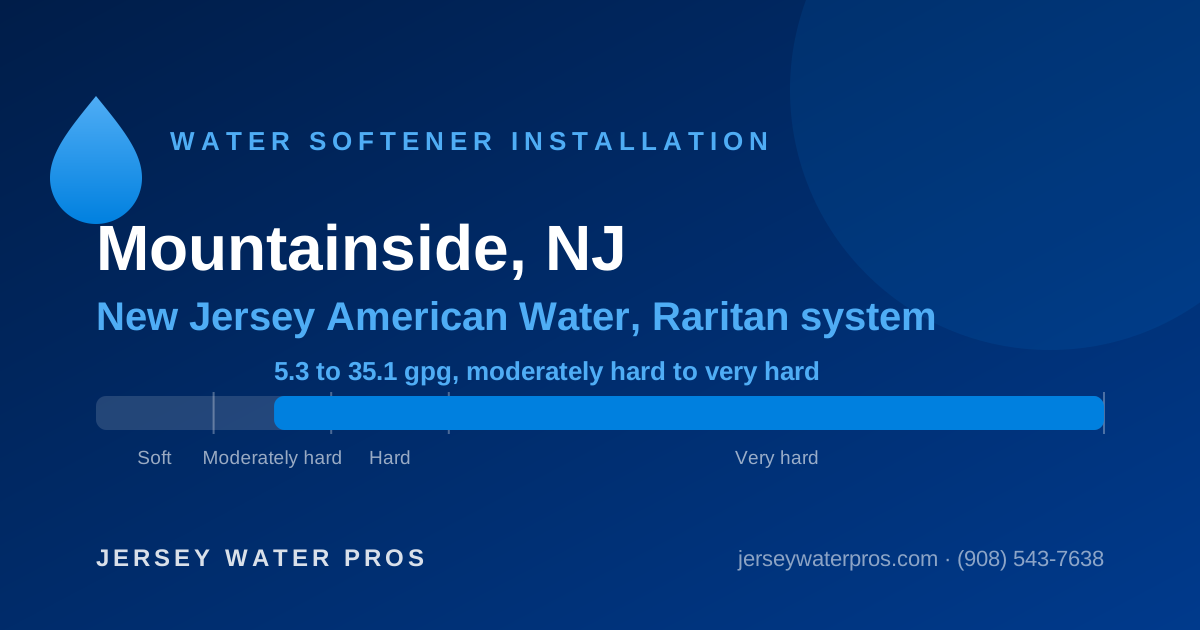
5.3 to 35.1 grains per gallon, moderately hard to very hard
County
Union County
Water softener installation in Mountainside, NJ begins with an unusually wide number. New Jersey American Water's typical water quality sheet for the zone that lists Mountainside 07092 puts total hardness at 90 to 600 mg/L as CaCO3, roughly 5 to 35 grains per gallon, because this part of the Raritan system blends river water with about 98 wells. A softener sized for the bottom of that range will not keep up at the top. This page walks Mountainside homeowners through the install itself, the hard water problems worth fixing, where whole house filtration belongs, and how cost takes shape before a free quote from a licensed NJ master plumber.
Mountainside water
What Mountainside homeowners are dealing with
The Borough of Mountainside's utilities page lists American Water among the utilities serving the borough, and the utility's own paperwork is more specific: Mountainside 07092 appears on New Jersey American Water's typical water quality sheet for Raritan System 3, one of the service zones inside the larger Raritan system, PWSID NJ2004002. The Jersey WaterCheck database lists Mountainside Borough among the municipalities the system serves, with roughly 736,800 people supplied system-wide.
That zone is where the numbers get interesting. Source water is a blend of seven intakes on the Raritan River, Millstone River, and Delaware & Raritan Canal with roughly 98 wells drawing from the Brunswick, Passaic, Stockton, glacial drift, and basalt aquifers. Because groundwater carries much more dissolved calcium and magnesium than river water, the utility's published hardness for this zone runs from 90 all the way to 600 mg/L as CaCO3, roughly 5 to 35 grains per gallon, printed on the same sheet as 3 to 35 grains. The same sheet lists sodium at 33 to 89 mg/L against a 50 mg/L secondary standard, manganese from non-detect to 0.04 mg/L, iron as not detected, and chloramine residuals of 0.5 to 1.4 mg/L in the distribution pipes.
Borough residents have also been living with pipe work. In February 2026 the borough posted that American Water would be replacing water main on Central Avenue over the next several weeks, with road closures possible. Across the system, the utility is identifying and replacing lead and galvanized service lines, and its contractors canvass neighborhoods door to door to confirm what each service line is made of, with an online survey for residents who prefer to self identify. To learn your own numbers, start with the utility's annual water quality report. Only NJDEP-certified lab results are official for a single tap, and we can help arrange that testing. Jersey Water Pros offers a free quote if you are considering treatment.
A very wide published hardness range
Mountainside 07092 is listed on New Jersey American Water's typical water quality sheet for Raritan System 3, which shows total hardness of 90 to 600 mg/L as CaCO3, roughly 5 to 35 grains per gallon, printed on the same page as 3 to 35 grains per gallon. This zone blends seven intakes on the Raritan River, Millstone River, and Delaware & Raritan Canal with roughly 98 wells in the Brunswick, Passaic, Stockton, glacial drift, and basalt aquifers, so the blend reaching one street can be much harder than the blend reaching another.
Sodium near and above the aesthetic limit
The utility's sheet for this zone lists sodium at 33 to 89 mg/L against a 50 mg/L secondary standard, and the Raritan system's 2025 annual water quality report lists 32 to 99 ppm against a 50 ppm recommended upper limit. The report notes that sodium levels above the recommended upper limit may be of concern to individuals on a sodium restricted diet. This matters when planning treatment, because ion exchange softening trades hardness minerals for a small amount of sodium and the amount rises with hardness.
Chloramine taste and the December 2024 taste and odor event
This part of the Raritan system disinfects with chloramines, with monthly average residuals of 0.5 to 1.4 mg/L in the distribution system per the utility's sheet. On December 16, 2024 a leak of alpha-pinene, described by the utility as a commonly used fragrance and food additive, from a repackaging facility in Branchburg entered a tributary of the Raritan River, with customer taste and odor complaints beginning the evening of December 17. The utility reported its samples continued to meet primary state and federal drinking water standards, and said that as of January 9, 2025 there should be minimal if any customers still observing the issue.
Main replacement work and lead service line identification
The Borough of Mountainside posted on February 18, 2026 that American Water would be performing a water main replacement project on Central Avenue over the next several weeks, warning that road closures may occur periodically throughout the project. Separately, the Raritan system's 2024 inventory reported by the Jersey WaterCheck database lists 7,449 known lead service lines and about 103,052 lines of unknown material system-wide. The system's 2025 annual report shows lead compliance was achieved with a 90th percentile of 2 ppb and none of the 54 sampled homes above the 15 ppb action level.
Water softener installation in Mountainside
A Mountainside water softener installation has one step ahead of everything else: pinning down your actual hardness. The utility's sheet for this zone spans 90 to 600 mg/L as CaCO3, roughly 5 to 35 grains per gallon, and equipment sized for the bottom of that range will fall behind at the top. We start from the utility's published figures for your area, and where the picture is unclear we help arrange a test through an NJDEP-certified lab before any equipment is chosen.
From there the work follows a standard path. A licensed New Jersey master plumber ties the softener into the main line after the meter and ahead of the water heater, with a bypass valve so the unit can be taken out of service without shutting down the house. Mountainside sits on the side of the first Watchung ridge, and the grade shows up indoors: split levels, walkout basements, and mechanical rooms tucked into a garage end or under a raised section of the house. None of that changes the plumbing, only where we stage equipment and how the drain line is routed.
Opening a supply line calls for a plumbing permit under New Jersey's Uniform Construction Code, filed with the Borough of Mountainside construction office. We prepare and file it and coordinate the inspection afterward. The physical installation usually takes a few hours to one day. At the harder end of the borough's range we spend extra time on programming and salt settings, because a system running near 30 grains per gallon has very little margin for a sloppy setup.
Mountainside hard water problems we fix
Mountainside is a small borough with two very different hard water stories, and which one you live with depends on the blend reaching your street. The utility's sheet for this zone lists 90 to 600 mg/L as CaCO3, roughly 5 to 35 grains per gallon, because the supply mixes seven river and canal intakes with about 98 wells drawing from the Brunswick, Passaic, Stockton, glacial drift, and basalt aquifers. Groundwater picks up far more dissolved calcium and magnesium than river water, so well-fed blocks run much harder than river-fed ones.
Near the low end, the symptoms are the familiar slow ones: spotted glassware, film on the shower door, scale creeping onto aerators, a water heater quietly losing efficiency. Near the top of the range, water behaves differently. Kettles crust in weeks, glass etches permanently, tankless heat exchangers narrow fast enough to trigger error codes, and tank heaters lose real capacity to sediment you can hear crackling when the burner fires.
Sodium is worth knowing about too. The utility's sheet for this zone lists 33 to 89 mg/L against a 50 mg/L secondary standard, and the system's 2025 annual report lists 32 to 99 ppm, noting that levels above the recommended upper limit may be of concern to individuals on a sodium restricted diet. Softening exchanges hardness minerals for a small amount of sodium, and the amount rises with hardness, so households watching sodium often pair a softener with reverse osmosis at the drinking tap.
Sizing is where this borough punishes shortcuts. At 30 grains, a household uses softening capacity roughly four times faster than at 7 grains, which drives resin volume, salt use, and regeneration frequency.
Whole house water filtration in Mountainside
Whole house water filtration in Mountainside usually starts with taste. This part of the Raritan system disinfects with chloramine, and the utility's sheet for the zone lists monthly average residuals of 0.5 to 1.4 mg/L in the distribution pipes. Chloramine holds up better than plain chlorine in long mains, which also makes it harder to remove at home. Catalytic carbon is the media designed for it, and installing carbon ahead of a softener protects the softening resin, which disinfectants degrade over time.
December 2024 was a reminder of how source water can change. A leak of alpha-pinene, which the utility described as a commonly used fragrance and food additive, from a repackaging facility in Branchburg reached a tributary of the Raritan River on December 16 and produced taste and odor complaints across the system from the following evening. The utility reported that its samples continued to meet primary state and federal drinking water standards throughout. Whole house carbon does not fix the river, but it does give your home a buffer.
On documented detections, the system's 2025 annual report lists PFOA at up to 7 ppt against New Jersey's 14 ppt MCL and PFOS at up to 6 ppt against 13 ppt, both in compliance. Homeowners who want a wider margin should look for equipment certified to NSF/ANSI 53 for reduction of PFOA and PFOS, or a reverse osmosis system certified to NSF/ANSI 58 at the kitchen sink. Lead here is a service line and household plumbing question rather than a source water one, and a tap filter certified to NSF/ANSI 53 for lead reduction is a sensible interim step.
What water treatment costs in Mountainside
Water treatment pricing in Mountainside cannot come off a chart, because the borough's published hardness range is too wide for one number to be honest. A home near the bottom of the range and a home near the top both need a softener, but not the same one. Capacity, resin volume, and sometimes a twin-tank design that regenerates one tank while the other keeps working all scale with hardness, and so does salt use over the years.
The other drivers are the usual ones: whether carbon filtration or a reverse osmosis unit joins the softener, how far the tie-in point sits from a drain and outlet, whether older pipe near the meter needs attention while it is open, and permit fees, which the Borough of Mountainside sets and which pass through at cost.
We do not offer water testing of any kind. This zone's hardness and disinfectant figures are already published by the utility in its annual water quality report, and questions about your own tap belong with an NJDEP-certified lab, which we can help arrange. The free quote is a visit from a licensed NJ master plumber who reviews the published numbers for your street, inspects the mechanical space, and leaves a written price covering equipment, labor, permits, and startup. There is no charge and no obligation, and we are based one town over in Summit, so service after the install stays local.
What we install in Mountainside
Jersey Water Pros is based in Summit and installs across Union County, with every job performed by a licensed NJ master plumber.
Water quality varies by street and season. Only a NJDEP-certified lab can produce official results for your own tap.
FAQ
Mountainside water questions
How hard is the water in Mountainside, NJ?
New Jersey American Water's typical water quality sheet for Raritan System 3, which lists Mountainside 07092, shows total hardness of 90 to 600 mg/L as CaCO3, roughly 5 to 35 grains per gallon, printed on the same page as 3 to 35 grains. On the USGS scale that covers moderately hard to very hard. The range is wide because this zone mixes river and canal water with roughly 98 wells, so the number at your tap depends on the blend feeding your street. The utility's annual water quality report, or an NJDEP-certified lab test we can help arrange, will confirm it.
Who supplies Mountainside's drinking water?
New Jersey American Water. The Borough of Mountainside's utilities page lists American Water as the water provider, and the utility's typical water quality sheet for Raritan System 3 lists Mountainside 07092 by name. The Jersey WaterCheck database also lists Mountainside Borough among the municipalities served by the Raritan system, PWSID NJ2004002, which supplies roughly 736,800 people.
Why has American Water been working on Central Avenue in Mountainside?
The Borough of Mountainside posted on February 18, 2026 that American Water would be performing a water main replacement project on Central Avenue over the next several weeks, and warned that road closures may occur periodically throughout the project. Main replacement projects like this typically also cover hydrants and utility-owned service lines along the route. Discolored water for a short period after main work is common and is usually cleared by running a cold tap.
Do I need a permit to install a water softener in Mountainside?
Yes. A softener ties into your home's supply line, which is plumbing work requiring a permit under New Jersey's Uniform Construction Code, filed with the Borough of Mountainside construction office. Jersey Water Pros prepares and files the paperwork, the installation is performed by a licensed NJ master plumber as state rules require, and the borough inspects the completed work.
How long does a water softener installation take in Mountainside?
The physical install usually runs a few hours to one day. What adds calendar time is the borough's permit review and inspection scheduling, and in some Mountainside homes a sizing step up front, because published hardness for this zone runs from 90 to 600 mg/L as CaCO3, roughly 5 to 35 grains per gallon, depending on the blend feeding your street. Confirming your number first prevents an undersized system, and we build the full timeline into your written quote.
Which water softener does Mountainside water need?
It depends entirely on where your address falls in the published range, which the utility puts at 90 to 600 mg/L as CaCO3, roughly 5 to 35 grains per gallon. Homes at the low end do well with a standard metered softener sized from daily water use. Homes at the harder, well-fed end need substantially more capacity, and sometimes a twin-tank design so soft water keeps flowing while one tank regenerates. Chloramine in the supply makes carbon filtration ahead of the softener worth discussing, both for taste and to protect the resin. We size from your street's actual number during the free quote.
Service area
Where we work in Mountainside
We install water softeners and whole house filtration across Mountainside and the surrounding Union County towns.
Ready to fix your water in Mountainside?
Get a straight written quote from a local pro. If your water's fine, we'll tell you that too.