Water Softener Installation in South Orange, NJ
Softeners, whole house filtration, and licensed plumber installs for South Orange homes, matched to what’s actually in South Orange’s water.
Water source
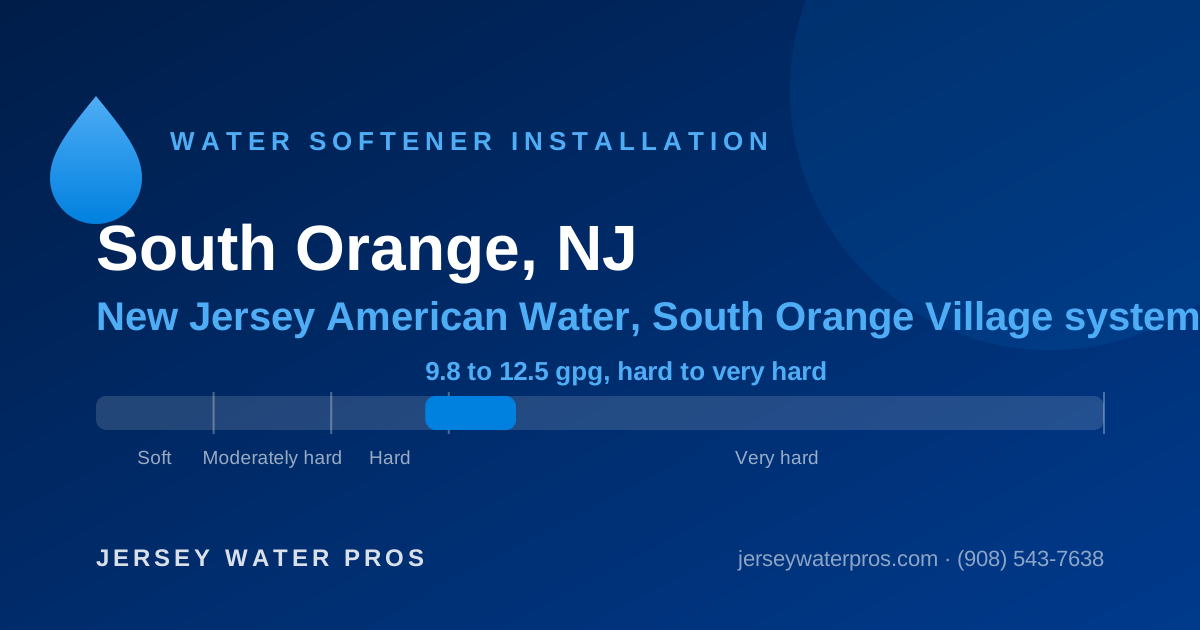
New Jersey American Water, South Orange Village system (PWSID NJ0719001)
Typical hardness
9.8 to 12.5 grains per gallon, hard to very hard
County
Essex County
Water softener installation in South Orange, NJ starts with a number that has been climbing: the Village system's annual reports put total hardness at 168 ppm in 2024 and 213 ppm in 2025, roughly 9.8 to 12.5 grains per gallon. The system changed hands in October 2025 when New Jersey American Water took ownership, but the water itself comes from the same blend it always has. This page covers the rest of the decision for South Orange homeowners: how an install works in the Village's older housing, which hard water problems a softener actually solves here, where whole house filtration fits, and how cost comes together before you get a free quote from our licensed NJ master plumbers.
South Orange water
What South Orange homeowners are dealing with
South Orange's water system changed hands recently. On October 7, 2025, New Jersey American Water assumed ownership of the assets of the South Orange Village Water Utility after a majority of residents voted to sell the system, and the acquired assets include the water mains, utility side service lines, hydrants, tanks, and reservoir. Before the sale, the Village owned the system outright, contracted its operation and maintenance to American Water under a ten-year contract, and bought bulk water from New Jersey American Water under a 30-year sales agreement. Both agreements commenced January 1, 2017. In practice, that means the water reaching South Orange taps has come from the same place for years: the Passaic River, Canoe Brook, and wells in the Brunswick aquifer, glacial sand and gravel, and igneous and metamorphic rock.
The hardness numbers in the Village's own reports moved noticeably. Total hardness was 168 ppm in the 2024 report and 213 ppm in the 2025 report, which works out to about 9.8 and 12.5 grains per gallon. Chloride rose from 68 to 103 ppm over the same period and sodium from 33 to 46 ppm, just under the 50 ppm recommended upper limit the report flags for people on sodium restricted diets. The system disinfects with chlorine, reported at 0.5 to 1.4 ppm entering the distribution system, which is the taste many residents notice at the kitchen tap.
The 2025 report states that in 2025 the water met state and federal drinking water requirements. PFOA was detected at 5 to 7 ppt and PFOS at up to 3 ppt, both below New Jersey's limits of 14 and 13 ppt, though EPA's federal limit of 4.0 ppt is lower still. Lead compliance was met with a 90th percentile of 2 ppb, but one of 35 sampled homes tested above the 15 ppb action level and results ranged as high as 40 ppb, which is a service line and home plumbing question rather than a source water one. To see the numbers behind your own tap, start with the utility's annual water quality report; only results from an NJDEP-certified lab are official, and we can help arrange a lab test. If you are weighing treatment, Jersey Water Pros offers a free in-home estimate.
Hardness that rose sharply between reports
The South Orange Village system's 2024 annual report listed total hardness at 168 ppm as CaCO3, sampled in 2024. The 2025 report lists 213 ppm, sampled in 2025. That is roughly 9.8 to 12.5 grains per gallon, a move from hard into very hard on the USGS scale, which sets very hard at more than 180 mg/L. Because the water is a purchased blend, hardness at any one tap can shift with the sources feeding the system, and at this level it builds scale in water heaters, on showerheads, and on glassware.
Chlorine taste and disinfection byproducts
The system disinfects with chlorine. The 2025 report lists a lowest residual of 0.5 ppm entering the distribution system with a range of 0.5 to 1.4 ppm, and a highest monthly average of 0.9 ppm in the pipes with a range of 0.5 to 0.9 ppm. Trihalomethanes reached a highest locational running annual average of 41 ppb across the system's four monitoring zones, with individual results from 14 to 48 ppb, against an 80 ppb limit. Haloacetic acids reached a highest running average of 13 ppb against a 60 ppb limit. All were in compliance.
One home above the lead action level in 2025
In 2025 tap sampling, the 90th percentile lead result was 2 ppb and compliance was achieved, but results ranged from non-detect to 40 ppb and one of the 35 sampled homes exceeded the 15 ppb action level. The Village says New Jersey American Water began work in South Orange on Monday, January 19, 2026 and will continue throughout 2026 and into 2027 until every water customer is tested for lead or galvanized lines, with replacement completed where needed. Under the July 2021 state law, all lead lines are to be replaced within ten years, with at least ten percent of the then known lead lines replaced per year.
PFOA below the state limit but above the federal one
The 2025 report lists PFOA at a highest compliance result of 7 ppt with a range of 5 to 7 ppt, against New Jersey's 14 ppt MCL, and PFOS at 3 ppt with a range of non-detect to 3 ppt against a 13 ppt MCL. Both are in compliance. EPA finalized national limits of 4.0 ppt for PFOA and PFOS in April 2024 with a compliance deadline of 2029, and has since proposed extending that deadline to 2031. South Orange's PFOA results sit above the 4.0 ppt federal number. Sodium and chloride also climbed between the 2024 and 2025 reports, from 33 to 46 ppm and from 68 to 103 ppm.
Water softener installation in South Orange
A South Orange softener install starts with a free quote visit from a licensed New Jersey master plumber, not a sales presentation. We find where the service line enters the house, confirm that a drain and a standard outlet are within reach, and check the condition of the pipe around the meter. The softener ties into the main line after the meter and ahead of the water heater, with a bypass valve so the unit can be serviced without shutting the house down. Outdoor spigots usually stay on untreated water so you are not softening the lawn.
The Village's older housing shapes the work more than it would in a newer town. In South Orange's prewar homes, basements can hide galvanized pipe near the meter, a main shutoff valve that has not moved in decades, or a mechanical room crowded by an old boiler. We look for all of that during the quote so nothing becomes a surprise on install day.
Cutting into a potable supply line changes the piping arrangement, so it falls outside the ordinary maintenance list in New Jersey's Uniform Construction Code and requires a plumbing permit, filed with the Township of South Orange Village construction office. We prepare and file that paperwork, and the installing plumber is the licensed NJ master plumber the code requires. The physical install usually runs a few hours to one day: setting the unit, cutting in the bypass, connecting the drain line, and programming the system to South Orange's published hardness. The Village inspection is scheduled afterward, and we walk you through salt, settings, and maintenance before we leave.
South Orange hard water problems we fix
South Orange's hardness is not static, and the utility's own reports show it. The 2024 report listed total hardness at 168 ppm. The 2025 report lists 213 ppm. That is a move from about 9.8 to about 12.5 grains per gallon, or from hard into very hard on the USGS scale, between two sampling years. Because the water arrives as a purchased blend, that kind of shift is normal, which is one reason we size equipment with headroom rather than to the minimum.
At 10 to 12 grains, the symptoms are not subtle. Minerals drop out wherever water is heated or left to dry: white crust around aerators and showerheads, spots on glassware out of the dishwasher, and a film on shower glass that returns two days after you scrub it. Inside a tank water heater, the same minerals settle as sediment that makes the burner run longer for the same hot water. Tankless units collect it in the heat exchanger. Dishwashers and washing machines need more detergent for a worse result, and towels come out stiff.
A metered softener sized to your household removes the calcium and magnesium at the point of entry, so nothing new forms downstream. The sizing math is straightforward: grains per gallon multiplied by the gallons your household uses each day sets the capacity you need between regenerations. At South Orange's level we run those numbers against the higher end of the published range, and we show you the math during the free quote.
Whole house water filtration in South Orange
Softening handles minerals but does nothing for taste. The South Orange Village system disinfects with chlorine, reported at 0.5 to 1.4 ppm entering the distribution system and a highest monthly average of 0.9 ppm in the pipes. Whole house carbon filtration removes chlorine taste and odor at the point of entry, and putting carbon ahead of the softener has a second benefit: it shields the softening resin, which disinfectants degrade over time. Carbon also works on the disinfection byproducts the report lists, with trihalomethanes at a highest running average of 41 ppb against an 80 ppb limit.
PFAS deserves a clear look here. The 2025 report lists PFOA at 5 to 7 ppt against New Jersey's 14 ppt limit and PFOS at non-detect to 3 ppt against 13 ppt, so the system is in compliance. EPA finalized national limits of 4.0 ppt for both compounds in April 2024 with a 2029 compliance deadline, and has since proposed pushing that deadline to 2031. South Orange's PFOA results sit above the 4.0 ppt figure. Homeowners who want a barrier now should choose equipment certified to NSF/ANSI 53 or NSF/ANSI 58 for reduction of PFOA and PFOS, either at the whole house or as a reverse osmosis unit at the kitchen sink.
Lead here is a service line and home plumbing question. In 2025 sampling the 90th percentile was 2 ppb and compliance was met, but one of 35 homes tested above the 15 ppb action level, with a high result of 40 ppb. Until your own line is confirmed, a drinking tap filter certified to NSF/ANSI 53 for lead reduction is a reasonable interim step. For your actual numbers, start with the utility's annual water quality report or an NJDEP-certified lab test we can help arrange.
What water treatment costs in South Orange
We do not publish flat prices for water treatment in South Orange, and it is worth being careful with any company that quotes one before seeing your basement. Cost here comes down to a short list.
- Equipment and capacity. A softener alone, a softener with whole house carbon, or a reverse osmosis unit at the sink are different projects, and capacity is sized to your household at hardness that has run 9.8 to 12.5 grains per gallon across the last two published reports.
- Install conditions. The distance from the tie-in point to a drain and outlet, and whether tired pipe near the meter needs attention while the line is open, both move labor.
- Permit fees. These are set by the Township of South Orange Village and pass through at cost.
One thing we will not do is the countertop water demonstration some companies use to close a sale. South Orange's hardness and disinfectant numbers are already published by the utility, and questions about lead or PFAS at your own tap belong with an NJDEP-certified lab, which we can help arrange. Quoting from real numbers keeps the recommendation honest, and New Jersey's consumer protection law is one more reason we prefer it that way.
The free quote is simple. A licensed NJ master plumber visits, inspects the tie-in and drain options, asks what you actually want fixed, and leaves a written quote that itemizes equipment, labor, and permit costs. There is no obligation, and the visit usually takes under an hour.
What we install in South Orange
Jersey Water Pros is based in Summit and installs across Essex County, with every job performed by a licensed NJ master plumber.
Water quality varies by street and season. Only a NJDEP-certified lab can produce official results for your own tap.
FAQ
South Orange water questions
How hard is the water in South Orange?
Hard to very hard, and it has been moving. The South Orange Village system's 2024 report listed total hardness at 168 ppm as CaCO3 and the 2025 report lists 213 ppm, which is about 9.8 to 12.5 grains per gallon. The USGS classifies anything over 180 mg/L as very hard, so the most recent published figure puts South Orange in that band. That is enough hardness to leave scale in water heaters, spot glassware, and film shower glass.
Who supplies South Orange's water now?
New Jersey American Water. On October 7, 2025 the company assumed ownership of the assets of the South Orange Village Water Utility after residents voted to sell the system, and it now owns the water mains, utility side service lines, hydrants, tanks, and reservoir. Before the sale, the Village owned the system, contracted its operation to American Water, and purchased bulk water from New Jersey American Water under a 30-year sales agreement that began January 1, 2017. Source water comes from the Passaic River, Canoe Brook, and wells in the Brunswick aquifer and glacial deposits.
Is there lead in South Orange's water?
The 2025 report shows lead compliance was met with a 90th percentile of 2 ppb, well under the 15 ppb action level. However, results ranged from non-detect to 40 ppb and one of the 35 sampled homes exceeded the action level, which points to individual service lines and home plumbing rather than the source water. The Village says New Jersey American Water started work in South Orange on January 19, 2026 and will continue through 2026 and into 2027 until every customer is tested and any needed replacement is completed. Only an NJDEP-certified lab result is official for your own tap, and we can help arrange a lab test.
Do I need a permit to install a water softener in South Orange?
Yes. A new softener ties into your home's potable supply line and changes the piping arrangement, which puts it outside the ordinary maintenance list in New Jersey's Uniform Construction Code and requires a plumbing permit, filed with the Township of South Orange Village construction office. Jersey Water Pros prepares and files the paperwork as part of the job, the installation is performed by a licensed NJ master plumber as the code requires, and the Village inspection is scheduled after the work is done.
How long does a water softener installation take in South Orange?
The physical install usually runs a few hours to one day, including setting the unit, cutting in the bypass, connecting the drain line, and programming the system to South Orange's published hardness. Permit filing and the Village inspection add calendar days around the install itself. In older South Orange basements we sometimes replace a tired shutoff valve or a short run of galvanized pipe at the tie-in point, which we flag in the written quote rather than on install day.
Which water softener is right for South Orange's water?
Most South Orange homes are well served by a standard metered softener sized to the household, but sized against the higher published number rather than the lower one, since total hardness went from 168 to 213 ppm between the 2024 and 2025 reports. Because the system disinfects with chlorine, many homeowners pair the softener with carbon filtration for taste and to protect the softening resin, and some add a reverse osmosis unit at the kitchen sink. The free quote sorts out which pieces your home actually needs.
Service area
Where we work in South Orange
We install water softeners and whole house filtration across South Orange and the surrounding Essex County towns.
Ready to fix your water in South Orange?
Get a straight written quote from a local pro. If your water's fine, we'll tell you that too.