Water Softener Installation in Union, NJ
Softeners, whole house filtration, and licensed plumber installs for Union homes, matched to what’s actually in Union’s water.
Water source
New Jersey American Water, Raritan System 3 (PWSID NJ2004002)
Typical hardness
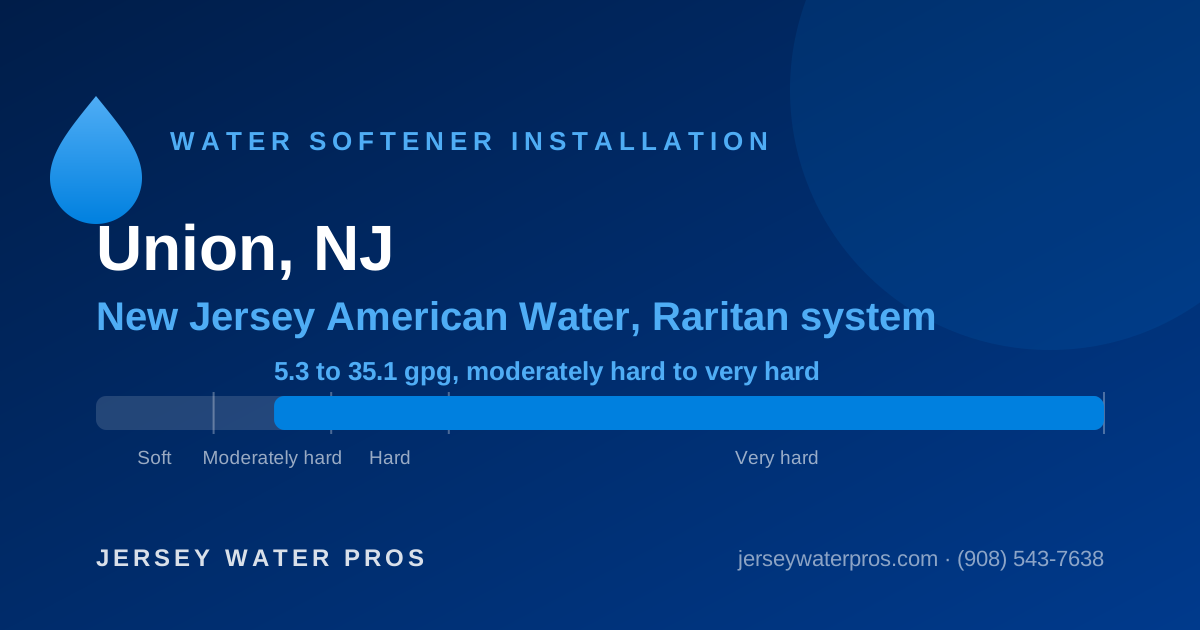
5.3 to 35.1 grains per gallon, moderately hard to very hard
County
Union County
Water softener installation in Union, NJ starts with a question most towns do not raise: which water are you actually on? New Jersey American Water's sheet for this part of the Raritan system, which lists Union 07083 and 07087 and Vauxhall 07088, puts total hardness anywhere from 90 to 600 mg/L as CaCO3, roughly 5 to 35 grains per gallon, because the supply blends river intakes with roughly 98 wells. The right softener on one Union street can be the wrong one a mile away. This page covers how an install works in the township, what that range does to a house, where whole house filtration fits, and how cost takes shape before your free quote.
Union water
What Union homeowners are dealing with
The Township of Union's own FAQ page answers the question directly: the water company serving the township is New Jersey American Water, listed there as New Jersey American Water Company northern division. Union and the Vauxhall section sit in what the utility calls Raritan System 3, one of the service zones inside the larger Raritan system, PWSID NJ2004002. The Jersey WaterCheck database lists Union Township among the municipalities the Raritan system serves, with roughly 736,800 people supplied system-wide.
What makes Union unusual is how much the water can vary. The utility's sheet for this zone lists total hardness of 90 to 600 mg/L as CaCO3, roughly 5 to 35 grains per gallon, and prints 3 to 35 grains on the same page. The supply mixes seven intakes on the Raritan River, Millstone River, and Delaware & Raritan Canal with roughly 98 wells across five aquifers. Groundwater carries far more dissolved calcium and magnesium than river water, so two Union households can honestly describe very different water. The same sheet lists sodium at 33 to 89 mg/L against a 50 mg/L secondary standard, iron as not detected, manganese from non-detect to 0.04 mg/L, and chloramine residuals of 0.5 to 1.4 mg/L in the distribution pipes.
The pipes under the township are part of the story too. On August 29, 2025 the utility announced a $1.3 million replacement of over half a mile of cast iron main on Broadwell Avenue, Beverly Road, and Lorraine Avenue, including hydrants, utility-owned service lines, and any customer-owned line found to be lead or galvanized, under a statewide initiative to remove all lead and galvanized service lines by 2031. The utility's contractors also canvass neighborhoods door to door to confirm service line materials, and customers can self identify through the utility's short online survey. To find your own numbers, start with the utility's annual water quality report. Only NJDEP-certified lab results are official for a single tap, and we can help arrange that testing. If you are weighing treatment, Jersey Water Pros offers a free quote.
Hardness that swings with the blend reaching your street
Union is listed on New Jersey American Water's typical water quality sheet for Raritan System 3, which names Union 07083 and 07087 and Vauxhall 07088. That sheet shows total hardness of 90 to 600 mg/L as CaCO3, roughly 5 to 35 grains per gallon, and prints 3 to 35 grains per gallon on the same page. The range is wide because this zone blends seven intakes on the Raritan River, Millstone River, and Delaware & Raritan Canal with roughly 98 wells in the Brunswick, Passaic, Stockton, glacial drift, and basalt aquifers. Well-fed blocks run far harder than river-fed ones, and even the low end builds scale in water heaters over time.
Cast iron mains from the 1950s being replaced
On August 29, 2025 New Jersey American Water announced a $1.3 million project to replace over half a mile of aging cast iron water main with new 8-inch ductile iron along Broadwell Avenue from Salem Road to Colonial Avenue, Beverly Road from Arnet Avenue to Lorraine Avenue, and Lorraine Avenue from Summit Place to Lum Avenue. The project also included replacing fire hydrants and utility-owned service lines along the route. The utility's contractor, Conquest, was scheduled to begin the week of September 8, 2025, with main installation finishing by the end of September 2025 and final street restoration by spring of 2026.
Lead and galvanized service lines still being identified
The 2025 Union main replacement included replacing any customer-owned service line identified as lead or galvanized, which the utility described as part of a statewide initiative to remove all lead and galvanized service lines by 2031. System-wide, the Raritan system's 2024 inventory reported by the Jersey WaterCheck database lists 7,449 known lead service lines and about 103,052 lines of unknown material. The system's 2025 annual water quality report shows lead compliance was achieved, with a 90th percentile of 2 ppb, a range of non-detect to 15 ppb, and none of the 54 sampled homes above the 15 ppb action level. The typical water quality sheet for this zone prints a 90th percentile of 5 ppb.
Chloramine taste, disinfection byproducts, and sodium
This zone disinfects with chloramines at monthly average residuals of 0.5 to 1.4 mg/L in the distribution system, per the utility's sheet. The 2025 annual report shows disinfection byproducts within limits, with the highest sampling location running an annual average of 46 ppb for total trihalomethanes against an 80 ppb MCL and 35 ppb for haloacetic acids against a 60 ppb MCL. Sodium ran 32 to 99 ppm against a 50 ppm recommended upper limit, which the report notes may be of concern to individuals on a sodium restricted diet. The same sheet lists iron as not detected and manganese from non-detect to 0.04 mg/L, so staining is not usually the issue here.
Water softener installation in Union
A water softener installation in Union starts at the meter, which in most of the township sits in the basement not far from the water heater. The softener ties in after the meter and ahead of the heater so every hot and cold line downstream carries treated water, with a bypass valve for service. The control valve needs a standard outlet and the regeneration cycle needs a drain. In a township this size we see every variation, from open basements with a floor drain a few feet away to finished lower levels where the routing has to be planned in advance.
Union's housing stock is unusually mixed for one municipality, running from prewar homes near Vauxhall and the Springfield Avenue corridor to postwar capes, split levels, and two-family houses. Older houses sometimes carry galvanized interior pipe near the tie-in point, which we evaluate before cutting in, because it can be close to the end of its life and it is far cheaper to address while the line is already open.
Permits are part of the job. A softener tie-in is a plumbing alteration under New Jersey's Uniform Construction Code, filed with the Township of Union construction office, and we prepare and file the paperwork. A licensed New Jersey master plumber performs the installation as state rules require, and the township inspects the finished work. Plan on a few hours to one day on site, plus township-paced time for permit review and the inspection visit. Before we leave, the control valve is programmed to the hardness figure your address actually carries, which matters here more than in most towns.
Union hard water problems we fix
Union sits in a zone of the Raritan system with one of the widest published hardness ranges we work with. New Jersey American Water lists 90 to 600 mg/L as CaCO3 for Raritan System 3, roughly 5 to 35 grains per gallon, and prints 3 to 35 grains on the same sheet. The spread exists because this zone blends seven river and canal intakes with roughly 98 wells across five aquifers, so two Union households can genuinely be describing different water and both can be right.
At the low end, hard water shows up as spotting on glassware, white crust on aerators and showerheads, and a water heater that slowly loses efficiency. Toward the high end it becomes something else. Scale returns within weeks of descaling, glass shower doors etch, tankless heaters throw errors as the heat exchanger narrows, and laundry stays stiff no matter how much detergent goes in.
The township's older mains add a second layer. In August 2025 New Jersey American Water invested $1.3 million to replace over half a mile of 1950s cast iron main with 8-inch ductile iron along Broadwell Avenue, Beverly Road, and Lorraine Avenue, along with fire hydrants and utility-owned service lines on the route. Aging pipe does not change hardness, but it does affect discolored water after main work, and it is one more reason conditions vary block to block.
A correctly sized metered softener stops new scale from forming at the point of entry. In Union, correct sizing is the whole game: at 30 grains per gallon a household uses up softening capacity roughly four times faster than at 7 grains, which changes resin volume, salt use, and how often the system regenerates.
Whole house water filtration in Union
Whole house water filtration in Union answers the questions a softener cannot. This part of the Raritan system disinfects with chloramine, and the utility's sheet for the zone lists monthly average residuals of 0.5 to 1.4 mg/L in the distribution system. That is what most people are tasting. Catalytic carbon at the point of entry is the media built for chloramine, and placing it ahead of a softener also shields the softening resin, which disinfectants degrade over time.
The system's 2025 annual water quality report gives filtration decisions real context. PFOA was reported at up to 7 ppt against New Jersey's 14 ppt MCL and PFOS at up to 6 ppt against 13 ppt, both in compliance, and the UCMR5 hazard index calculation for the four-PFAS mixture came out below 1. Sodium ran 32 to 99 ppm against a 50 ppm recommended upper limit. Disinfection byproducts stayed within limits, with the highest sampling location averaging 46 ppb for total trihalomethanes against an 80 ppb limit and 35 ppb for haloacetic acids against 60 ppb.
For households that want a margin below compliance, the credible route is equipment independently certified to NSF/ANSI 53 for reduction of PFOA and PFOS, or a reverse osmosis system certified to NSF/ANSI 58 at the kitchen sink, rather than brochure language. Because thousands of lead and unknown-material service lines are still being identified across this system, a drinking tap filter certified to NSF/ANSI 53 for lead reduction is a reasonable interim step until your own line is confirmed.
What water treatment costs in Union
Honest pricing for water treatment in Union depends on which of the township's water problems your house actually has, so we quote after seeing the house rather than publishing a number that fits nobody. The drivers are straightforward.
- Where your street falls in the range. A home near 6 grains per gallon needs a very different softener than one near 30.
- Scope. Softener alone, whole house carbon for chloramine taste, a certified drinking water system, or a combination.
- Site conditions. Tie-in location, drain and outlet access, and any galvanized pipe worth addressing while the line is open.
- Permit fees, set by the Township of Union and passed through at cost.
Operating cost stays modest when the sizing is right, because a demand-initiated softener regenerates on actual water use rather than a timer, so salt and rinse water track your household instead of the calendar.
We do not offer water testing of any kind, and we do not quote equipment over the phone. The utility publishes this zone's numbers in its annual water quality report, and official results for your own tap come from an NJDEP-certified lab, which we can help arrange. The free quote is a visit from a licensed NJ master plumber, an inspection of your plumbing and mechanicals, and a written price itemizing equipment, labor, permits, and startup. No charge and no obligation.
What we install in Union
Jersey Water Pros is based in Summit and installs across Union County, with every job performed by a licensed NJ master plumber.
Water quality varies by street and season. Only a NJDEP-certified lab can produce official results for your own tap.
FAQ
Union water questions
How hard is the water in Union, NJ?
New Jersey American Water's typical water quality sheet for Raritan System 3, which lists Union 07083 and 07087 and Vauxhall 07088, shows total hardness of 90 to 600 mg/L as CaCO3. That is roughly 5 to 35 grains per gallon, and the utility prints 3 to 35 grains on the same page. On the USGS scale, 90 mg/L is moderately hard and 600 mg/L is very hard. The spread is wide because this zone blends river water with roughly 98 wells, so your block's number depends on which sources feed it. The utility's annual water quality report, or an NJDEP-certified lab test we can help arrange, will pin it down.
Who supplies water to Union Township and Vauxhall?
New Jersey American Water. The Township of Union's FAQ page names New Jersey American Water Company as the water utility serving the township, and the utility's typical water quality sheet for Raritan System 3 lists Union 07083 and 07087 and Vauxhall 07088. Source water for this zone comes from seven intakes on the Raritan River, Millstone River, and Delaware & Raritan Canal plus roughly 98 wells in the Brunswick, Passaic, Stockton, glacial drift, and basalt aquifers.
What was the 2025 water main work on Broadwell, Beverly, and Lorraine?
New Jersey American Water announced a $1.3 million project on August 29, 2025 to replace over half a mile of aging cast iron main with new 8-inch ductile iron pipe along Broadwell Avenue from Salem Road to Colonial Avenue, Beverly Road from Arnet Avenue to Lorraine Avenue, and Lorraine Avenue from Summit Place to Lum Avenue. The project also replaced fire hydrants and utility-owned service lines, and the utility said it would replace any customer-owned service line identified as lead or galvanized as part of a statewide initiative to remove all such lines by 2031. Its contractor, Conquest, was scheduled to start the week of September 8, 2025, with final street restoration by spring of 2026.
Do I need a permit to install a water softener in Union, NJ?
Yes. Tying a softener into your supply line is a plumbing alteration under New Jersey's Uniform Construction Code, permitted through the Township of Union construction office. Jersey Water Pros prepares and files the paperwork as part of the job, a licensed NJ master plumber performs the installation as state rules require, and the township inspects the finished work.
How long does a water softener installation take in Union?
Plan on a few hours to one day of on-site work for a typical single-family home: setting the unit, cutting in the bypass, connecting the drain line, and programming the control valve. Older houses with galvanized pipe near the tie-in can take longer if a section needs replacing. Permit review and the township inspection add calendar time around the install, and your written quote includes the full expected timeline.
Which water softener is right for Union's water?
It depends on where your block falls in the published range for this part of the Raritan system, which the utility puts at 90 to 600 mg/L as CaCO3, roughly 5 to 35 grains per gallon. Homes at the low end do well with a standard metered softener sized from daily water use. Homes at the harder, well-fed end need substantially more capacity, and sometimes a twin-tank design that keeps soft water flowing while one tank regenerates. Because the supply is chloraminated, carbon filtration ahead of the softener is worth discussing for taste and for resin protection. We size it during the free quote.
Service area
Where we work in Union
We install water softeners and whole house filtration across Union and the surrounding Union County towns.
Ready to fix your water in Union?
Get a straight written quote from a local pro. If your water's fine, we'll tell you that too.